 MEIKAI
How many times should you run an AI visibility prompt?
Following recent industry debate about whether reliable AI visibility measurement requires running the same prompts multiple times per day, we decided to test the question ourselves.
Over ten consecutive days, Meikai collected 250,000 responses from a fixed portfolio of 500 prompts across ChatGPT, Copilot, Gemini, Google AI Mode and Perplexity. Every prompt ran through ten independent repeat arms each day. We then compared what a measurement policy would have reported using one, two, three, five or all ten runs.
Repeating prompts more often within a day improved precision, but did not materially change the pooled ten-day citation-share or visibility result.
That distinction matters. AI answers do vary. The practical question is not whether variation exists, but whether paying for more same-day repetitions changes the decision a broad portfolio measurement supports.
The question behind the experiment
Recent research has rightly challenged one-off AI visibility checks. A single response is not a stable measurement because answers can change across runs, prompt formulations and time. The paper Don't Measure Once: Measuring Visibility in AI Search (GEO) argues that visibility should be treated as a distribution rather than a single-point outcome.
We asked a narrower operational question. If a team measures a large, fixed prompt portfolio every day for ten days, does it need to run every prompt ten times per day to recover a reliable portfolio-level result?
This is different from asking whether one isolated answer can be trusted. Here, 1x/day means one run for every prompt-platform pair on each of the ten days, not one response observed once.
How the study worked
| Study element | Design |
|---|---|
| Observation window | 13-22 July 2026, ten consecutive days |
| Prompt portfolio | 500 fixed US English prompts |
| Platforms | ChatGPT, Copilot, Gemini, Google AI Mode and Perplexity |
| Repeat design | Ten independent whole-portfolio arms per day |
| Study sample | 250,000 responses |
| Policies compared | 1x, 2x, 3x, 5x and 10x per day |
| Primary metrics | Citation share and average top-10 visibility |
For each policy, we repeatedly sampled complete portfolio arms across the same ten dates. We compared each simulated result with the all-arm estimate for that window. The reported p95 sampling error is the 95th percentile of that absolute difference, expressed in percentage points.
Put simply: the expected value tells us where the estimate is centred. The p95 error tells us how far a sampled policy can typically move around that centre.
The result: the same estimate with a tighter range
The pooled ten-day estimates were 20.52% citation share and 15.76% average top-10 visibility. Increasing execution from one to ten runs per day did not materially move those expected values. It only narrowed the sampling range around them.
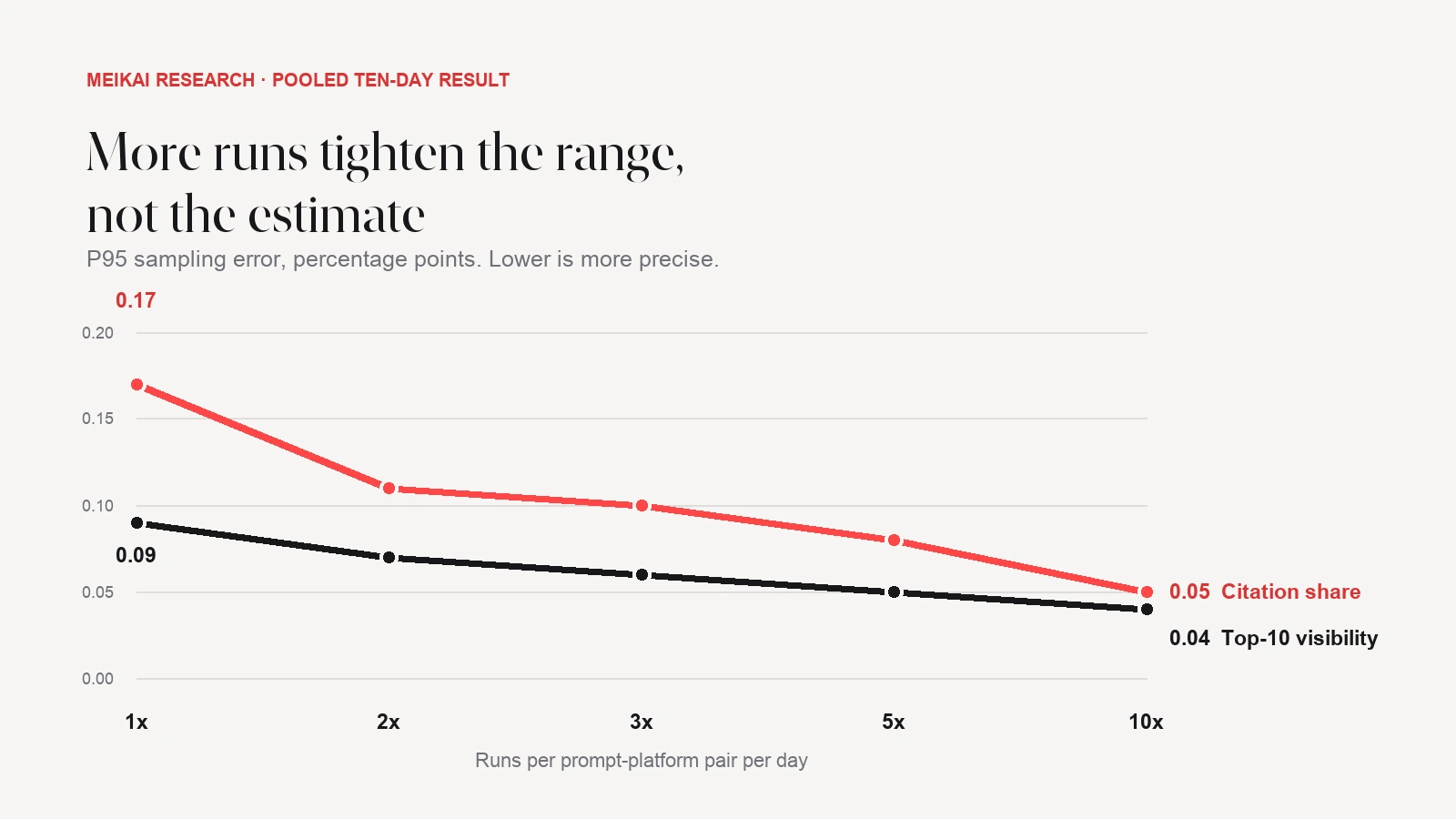
| Runs per day | Citation-share p95 error | Top-10 visibility p95 error |
|---|---|---|
| 1x | 0.17 pp | 0.09 pp |
| 2x | 0.11 pp | 0.07 pp |
| 3x | 0.10 pp | 0.06 pp |
| 5x | 0.08 pp | 0.05 pp |
| 10x | 0.05 pp | 0.04 pp |
At 1x/day, 95% of the simulated ten-day citation-share estimates were within 0.17 percentage points of the all-arm estimate. For top-10 visibility, the equivalent error was 0.09 percentage points.
Ten repetitions reduced those errors to 0.05 and 0.04 percentage points respectively, but at ten times the response cost. The extra execution bought precision, not a different pooled answer.
The platform-level exception
The pooled result does not mean every platform had identical variability. Copilot's citation share was the clearest exception: its ten-day p95 error was 1.33 percentage points at 1x/day and 0.49 percentage points at 10x/day. Three runs per day was the first tested policy to bring it below a one-percentage-point comparison guide.
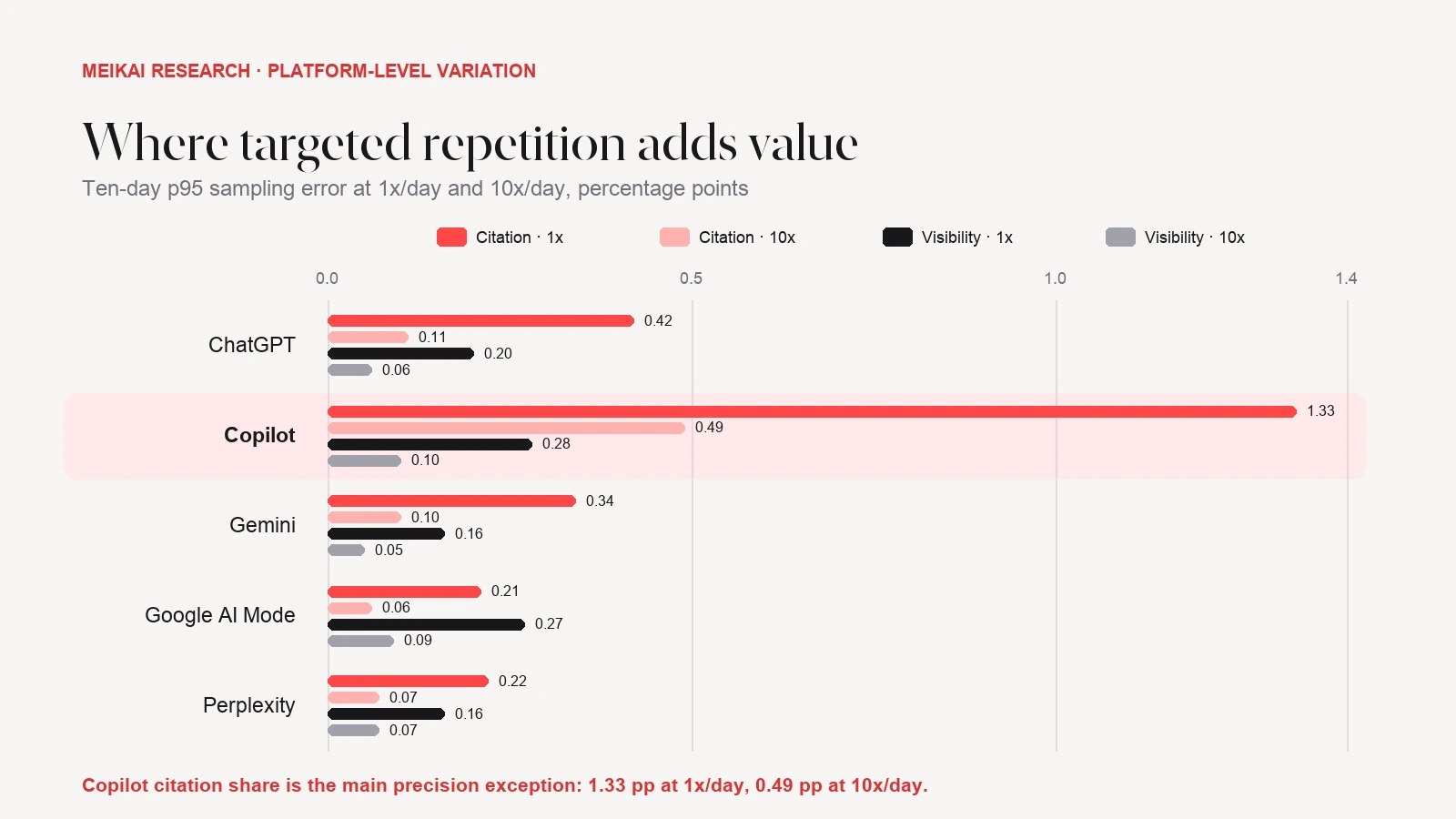
This is why a single repetition rule is inefficient. A broad portfolio can be stable while one platform-metric pair still benefits from extra runs. The better policy is to repeat selectively where the remaining uncertainty could change a comparison or decision.
Methodology note
Each execution policy was evaluated by repeatedly sampling complete daily runs across the same ten dates and comparing the result with all ten runs. A sensitivity check using every available response produced the same conclusion.
The findings apply to this 500-prompt US English portfolio and ten-day window. Smaller portfolios, single-prompt diagnostics and intraday measurements may need more repetition.
What this means for AI visibility measurement
- Treat repetition as a precision choice, not a default requirement. In this study, one daily run per prompt and platform produced the same pooled ten-day signal as ten runs.
- Repeat selectively where uncertainty can change a decision. Platform-level comparisons and more variable metrics, such as Copilot citation share, gain the most from additional runs.
- Invest in representative prompts once precision is adequate. Broader and better-modelled demand may add more measurement value than repeating the same sample. Our prompt-modeling framework explains why.
Run broadly and consistently first. Add repetition when the extra precision can change the decision.