 MEIKAI
Is a persona suffix a fair stand-in for logged-in AI memory?
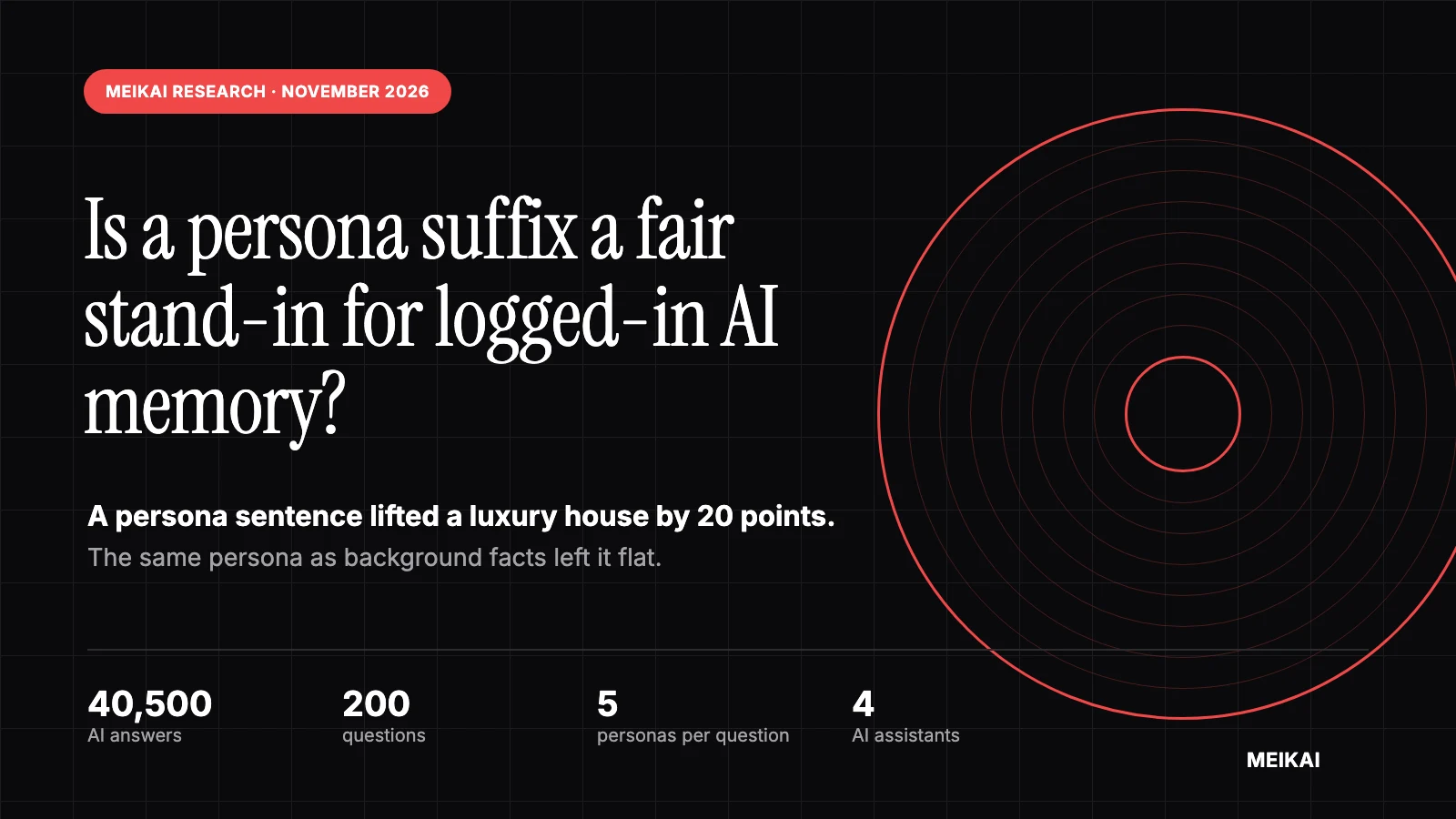
Logged-in assistants remember their users, and AI visibility tools cannot see what those users see. Some trackers fill the gap by asking each question once per persona, with a sentence such as “I'm a woman over 50 looking for prestige products” added to the prompt. We tested what that sentence measures.
Meikai collected about 40,500 answers from ChatGPT, Gemini, Google AI Mode and Perplexity in September and October 2026: 200 brand-recommendation questions in French beauty and US premium beverages, five personas each.
On ChatGPT in France, a persona sentence raised the visibility of a leading French beauty brand by 20 percentage points. Given the same persona as background facts, the way memory holds it, the brand moved by −1 point.
The question behind the experiment
Memory holds facts about the user from earlier conversations, most of them unrelated to the question, and the assistant decides which ones matter. A persona suffix states the profile in the question, every time. Real memory cannot be observed logged-out, so we tested the closest thing: does an assistant answer the same way when the persona arrives as background facts instead of a sentence?
One beverages question, for the persona “soda quitter”:
| Formulation | Prompt sent |
|---|---|
| Plain question | What are the best sparkling water brands for mixing cocktails? |
| Persona sentence | What are the best sparkling water brands for mixing cocktails? I'm someone trying to quit soda and cut sugar. |
| Placebo facts | A few things I've told you in earlier chats: I'm learning Spanish on weekends. I have a dog named Max. I usually work from home on Fridays. I'm planning a hiking trip next spring. My question: … |
| Background facts | The placebo facts plus two persona facts: “I'm trying to quit my two-cans-a-day soda habit” and “I want to cut sugar but I miss the fizz”. |
Any preamble changes an answer a little, so we compared background facts against placebo facts, not against the plain question. The difference is the effect of the persona itself.
How the study worked
| Study element | Design |
|---|---|
| Questions | 200, five personas each: French beauty (asked in French) and US premium beverages (asked in English) |
| Assistants | ChatGPT, Gemini, Google AI Mode and Perplexity; background facts on ChatGPT only |
| Study sample | About 40,500 answers, September to October 2026, logged-out |
| Runs | Plain questions five times, each persona formulation three times per persona |
| Primary measures | Visibility (share of answers naming a brand) and answer change |
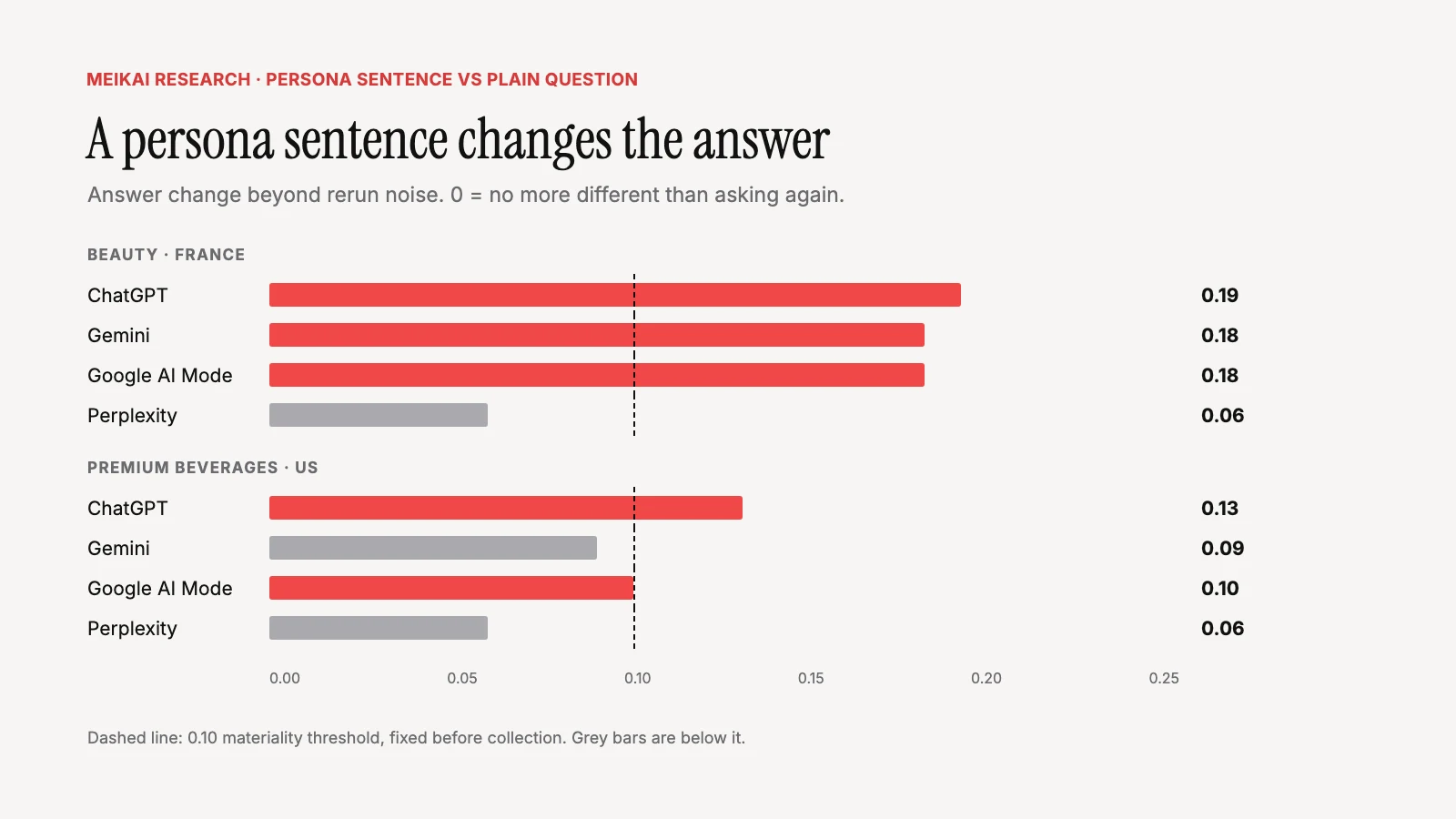
Two runs of the same plain question shared only 33% to 61% of the brands they named, so answer change is measured net of that noise: the difference between the brands named under two formulations, minus the difference between two runs of the same one. Zero means no more change than asking again. We fixed 0.10 as the threshold for a material change before collecting any data.
The result: the sentence moves brands, the facts barely do
Persona sentences changed answers on all four assistants beyond rerun noise, and materially on five of the eight assistant and segment combinations. On ChatGPT, the beauty answer change was 0.19, then 0.17 in a second collection days later.
As background facts, most of that effect faded. On ChatGPT, 17% of the answer change survived in beauty and 47% in beverages, both below the threshold.
| ChatGPT | Persona sentence vs plain question | Background facts vs placebo facts |
|---|---|---|
| Beauty, answer change | 0.17 | 0.03 |
| Premium beverages, answer change | 0.12 | 0.05 |
| The brand's visibility, France | +20.4 pp | −0.9 pp |
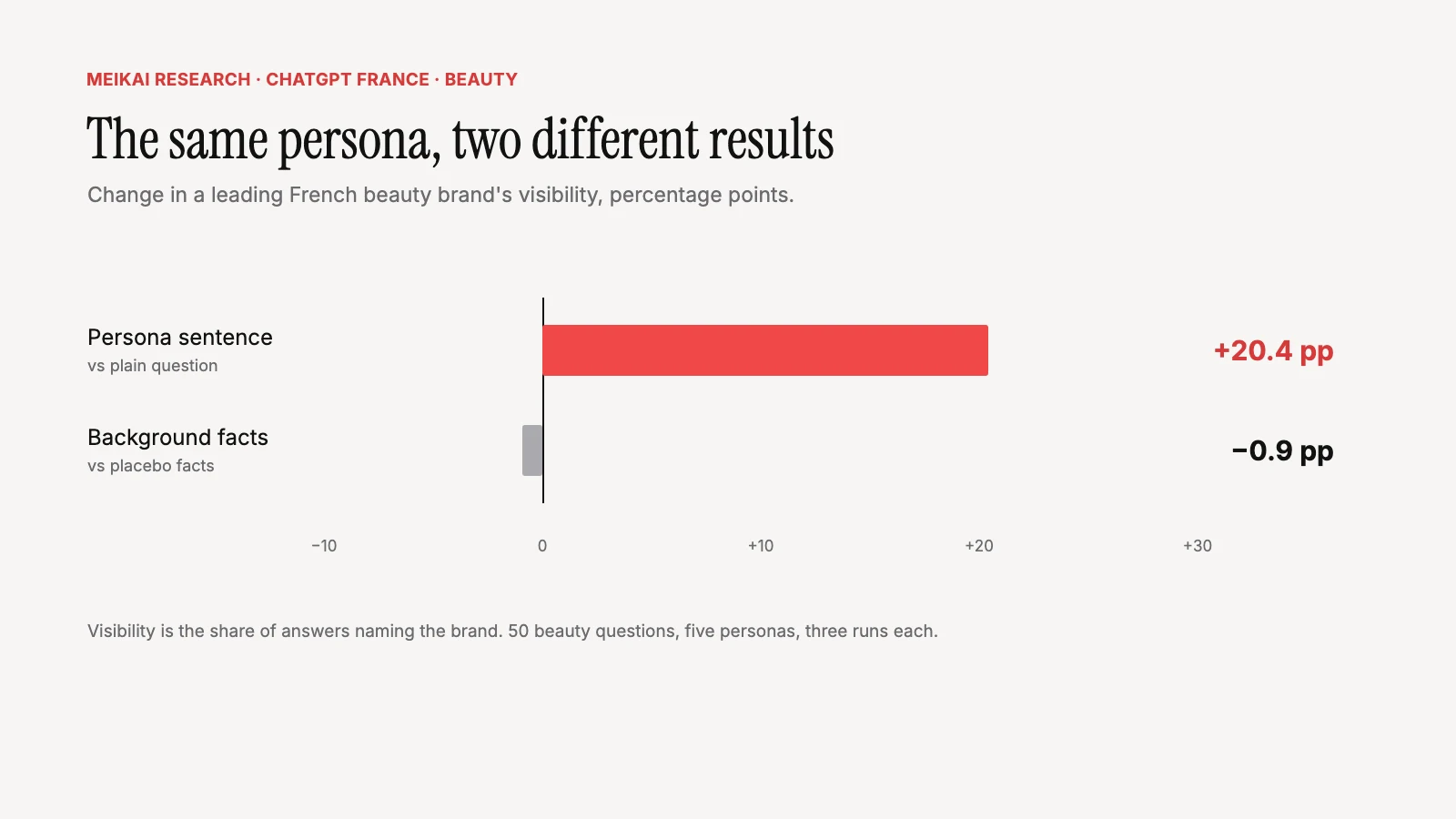
The persona facts did register: some answers mentioned the user's age or soda habit. The brand's lift still appeared only when the persona was written into the question.
Asked “Can you recommend brands of perfumed hair mist?”, ChatGPT named the brand in 2 of 5 plain answers, 0 of 5 with placebo facts, 12 of 15 with a persona sentence and 2 of 15 with background facts. For the persona “mature-skin prestige care”, the persona-sentence answer opened with “First choice if you want prestige: [the brand's] hair mist”; the background-facts answer pointed to a mass-market brand. This is the beauty question with the largest persona-sentence lift; across all 50 beauty questions on ChatGPT, the background-facts lift was close to zero.
Persona gaps shrink too
Built from persona sentences, the differences between audiences look larger than background facts support.
| ChatGPT | Persona sentence | Background facts |
|---|---|---|
| The brand, best persona minus worst persona | 27 pp | 13 pp |
| Beauty, answer change between personas | 0.11 | 0.04 |
| Beverages, answer change between personas | 0.17 | 0.08 |
As sentences, beauty personas differed from each other by 0.11, about as much as two wordings of the same question (0.13). As background facts they barely differed.
The shift also ran one way. Every material brand shift caused by a persona sentence was upward, 10 of 10 brand and assistant combinations across both segments, so totals summed across personas inflate visibility instead of averaging out.
Placing the sentence before the question instead of after it made no material difference in French beauty on any of the three assistants tested. In US beverages the result is inconclusive.
Methodology note
Uncertainty ranges come from resampling whole questions, and every threshold was set before collection. Persona labels and descriptions were written for the study. Trackers' exact templates were not available, so we reconstructed the persona sentence; a richer persona preamble behaved similarly.
The findings have clear limits:
- Logged-out only. Background facts pasted into the prompt approximate memory and do not replace logged-in data.
- Explicit persona settings were not tested. A user who describes themselves in account settings or custom instructions may get answers closer to the persona-sentence result.
- Background facts were tested on ChatGPT only. Other assistants may weigh them differently.
- Two segments, one market each. The results do not establish the same effect for every brand, market or question.
The first test to run if logged-in sampling becomes possible is whether real memory weighs persona facts as heavily as a written sentence.
Reading persona-level visibility
- Treat persona-sentence visibility as an upper bound. The brand gained 20 points from a persona sentence and about nothing from the same persona as background facts.
- Read persona-to-persona gaps with caution. In beauty, personas that looked different as sentences barely differed as background facts.
- Do not add up persona results. The bias runs one way, so persona-multiplied totals overstate visibility.
A persona in the prompt tells you how an assistant responds to being told who the user is. It does not tell you what a logged-in user sees.