 MEIKAI
How to Improve ChatGPT Visibility and Make Ads for Black Friday, Cyber Monday and Christmas
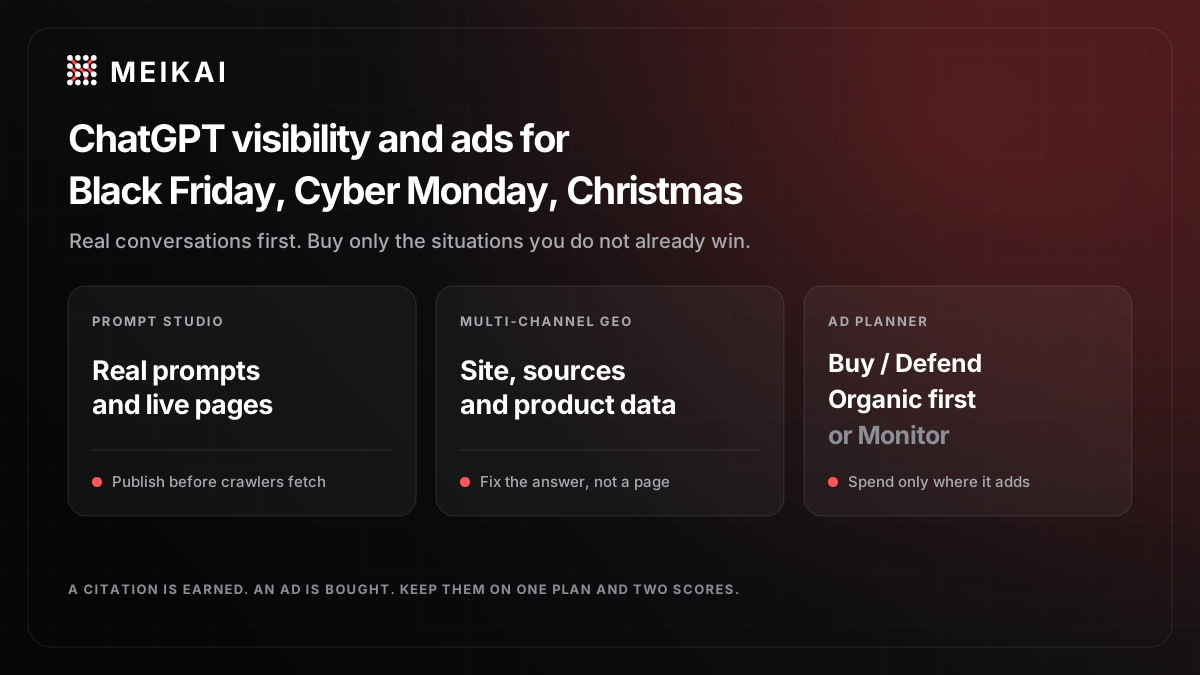
To improve ChatGPT visibility for Black Friday, Cyber Monday and Christmas, organise the conversations shoppers actually have. Publish the pages those conversations need. Then check whether you are named in the answer. To make ChatGPT ads efficiently for the same peaks, use that prompt model as the media brief. Buy only the situations you do not already win.
Shoppers do not type “headphones Black Friday” into ChatGPT. They describe a sister who just started running, a crossed-out price they do not trust, a parcel that has to arrive before the 24th. ChatGPT then names a brand in the answer, or it does not. There is no ranking to climb.
Meikai's holiday workflow is the same as the rest of the year: Prompt Studio to build the topic model from real prompts, pages live early enough for crawlers to fetch them, daily monitoring of the answers, optimisation agents on the organic gaps. Ad Planner only where a ChatGPT ad adds reach you have not already earned. That first step is not a research ritual. ChatGPT ads are matched on situations, not keywords. The prompt model is the brief Ad Planner spends against.
Disclosure and method. Meikai is an AI visibility and advertising planning platform, so this is a vendor writing about a market it operates in. Product capabilities reflect what is documented on this site at publication. Facts about ChatGPT Ads and OpenAI crawlers come from OpenAI's published help material; availability, formats and pricing move quickly and should be checked against current documentation. This article does not claim a guaranteed outcome.
How to improve ChatGPT visibility for Black Friday, Cyber Monday and Christmas
You improve ChatGPT visibility when you are named in the conversations that happen, not when you rank a keyword. For Black Friday, Cyber Monday and Christmas that is four steps: build the prompt set from real shopper conversations in Prompt Studio; publish the gift, deal and delivery pages those topics need before crawlers come looking; read the answers daily (shortlist, framing, sources); close the gaps with on-site and off-site optimisation agents, Site Scanner and Product Tracker.
How to make ChatGPT ads efficiently for Black Friday, Cyber Monday and Christmas
You make ChatGPT ads efficiently by not buying the whole category. Ads match on situations, not keywords. They do not change the organic answer. The same holiday prompt set is the brief. Ad Planner classifies each cluster as Buy ads, Defend, Organic first or Monitor. It writes context hints in the language of those prompts. You push only Buy and Defend to OpenAI Ads Manager. A keyword list in September becomes a keyword campaign in November.
Start from real conversations, not a holiday keyword list
A keyword list treats those four situations as one bid. In ChatGPT they cite different sources and often recommend different brands. Prompt Studio exists so the measurement set is sampled from that variation, not invented from last year's search export.
| Moment | What people actually ask | What a keyword list misses |
|---|---|---|
| Gift | “Something for my sister who just started running, under 80 euros” | The person, the constraint, the occasion |
| Deal | “Is this Black Friday price actually lower than last month?” | Trust in the discount, not the product name |
| Delivery | “What can still arrive before Christmas if I order today?” | Cut-off dates and local availability |
| Setup | “Laptop for a student who already has a tablet” | The kit they already own |
That is the sampling problem in our prompt-modeling method: keep enough variation to change the answer, record why each prompt exists. Do not multiply every wording. For Q4, keep a core set (gift, deal, delivery) and a smaller exploratory layer for language that appears after mid-November. Keep November and December as separate versions. A December prompt about same-day pickup does not belong in the November baseline.
Those four rows are four different ChatGPT ad groups. OpenAI matches a labelled placement to a situation. Flatten gift, deal and delivery into “headphones Black Friday” and the context hint becomes a keyword with extra words. You bid once. You sit in conversations you already win. You miss the ones you lose. Organise the set from real conversations first, or Ad Planner has nothing honest to classify or to write hints from.
Prompt Studio first, then pages that actually exist
Prompt Studio is where that set is built. It combines real consumer prompts, search and site signals and observed AI interactions. It groups them by persona, topic and cluster. A review step sits before import so the holiday set is chosen rather than dumped into monitoring. Whether a theme has real volume is checked against the same opt-in partner panel (more than two billion prompts) used elsewhere on the platform. A slogan with no volume does not belong in the brief.
Once the topics are set, the pages have to be on the open web. Site Scanner is the practical reason to publish early: it scores AI readability and whether LLM crawlers actually visit the page. On sites we scan, those crawlers miss 50%+ of pages. They do not behave like Google. The bots in that view are GPTBot, ClaudeBot, Gemini and PerplexityBot. OpenAI's ad and search crawlers are a separate requirement. Advertiser crawler guidance requires OAI-AdsBot on ad landing pages, because that bot reviews the page and can use it to judge relevance. OAI-SearchBot is recommended so ChatGPT search can surface public content. A robots.txt change can take about a day. A gift guide still in draft on 20 November is invisible to all of them.
Read the answer, not a mention score
Run the reviewed prompt set daily on ChatGPT. Look at the response itself.
- Shortlist. Named among the options, or only mentioned in passing?
- Framing. Reliable, cheapest, last-minute, or the one ChatGPT warns against?
- Sources. Which URLs are cited? Are they still live, priced and in stock?
- Ads. Did a labelled placement already trigger next to that conversation? Whose?
A citation is not a recommendation; the retail visibility guide keeps those outcomes apart. Product Tracker is the SKU layer of the same check: how the product is described, whether it is recommended, which competitor sits in the shortlist. If a theme has no volume in real prompts, drop it from the brief. If volume is high and you are absent, that is work for optimisation or media.
Fix the sources the answer is built from
ChatGPT assembles an answer from pages it can retrieve and sources it already trusts. For holidays that is usually product pages, gift guides, retailer listings, reviews and explainers, plus the facts those pages get wrong: price, stock, cut-off, returns. Optimisation agents run that as one programme: on-site updates and new pages on the topics Prompt Studio surfaced, including product pages the model misdescribes; off-site work toward publishers and creators already cited in the category. Site Scanner tells you whether those pages are readable and whether LLM crawlers actually visit them. An AI crawlability audit is the check before a November rewrite of a URL the crawler never fetches.
What efficient ChatGPT ads look like for Black Friday and Christmas
OpenAI states that ads do not influence ChatGPT's organic answers. An impression is bought; a citation is earned. Ad Planner sits on the same monitored responses and prompt model as the rest of the platform. It keeps paid delivery and organic movement on separate scores. The Ad Planner article covers the mechanics. It can only classify Buy or Defend from conversations you chose to monitor. It can only draft context hints from those same conversations. A holiday keyword list in September becomes a keyword campaign in November. For Q4 the rule is narrower: do not bid on every festive theme you can name.
| Action | When it is the right Q4 move |
|---|---|
| Buy ads | Real prompt volume is high. Ads already trigger. You are missing from the organic shortlist |
| Defend | You are already recommended, but competitors are buying the same context |
| Organic first | The cheaper fix is a page, a product fact or a cited source |
| Monitor | Demand is rising, but it is not yet worth spend or a rewrite |
A worked Black Friday brief
Take the four holiday rows above as one audio-brand illustration. This is not a live campaign and not a result. The actions are what Ad Planner would return if monitoring showed this pattern: gift volume high and the brand missing from the shortlist; deal questions citing comparison pages the brand does not own; delivery questions where the brand is already named and competitors are buying; setup demand rising but ads barely triggering.
| Cluster | Action | What you build |
|---|---|---|
| Gift | Buy ads | Context hint: someone looking for a useful gift under 80 euros for a sister who just started running. Landing: the sub-80 collection, not the homepage. |
| Deal | Organic first | No ad group. Publish a page that puts today's Black Friday price next to last month's. ChatGPT is already citing comparison pieces; buying the slot does not make you the source. |
| Delivery | Defend | Context hint: ordering today and needs the parcel to arrive before Christmas. Landing: the Christmas cut-off page. You are already named; competitors are buying the same situation. |
| Setup | Monitor | Leave it. Volume is rising; ads barely trigger. Revisit in December if last-minute kit prompts take over. |
Three landings, not one homepage. OpenAI's ad-group guidance says to split the group if the landing page would have to change. That is the efficiency: one category, four situations, two buys, one page to write, one line left alone.
From a Buy or Defend line, Ad Planner drafts a ChatGPT ad group. Context hints come in the language of the monitored prompts. Bid guidance is informed by how strong you already are organically. Chat cards are grounded in your real offers. Every field is editable. Push the campaign to OpenAI Ads Manager when it is ready. Template export remains as a fallback. Meikai does not sell the inventory. It can recommend that you leave a line alone.
The draft still has to satisfy OpenAI's own setup. Ad-group guidance keeps each group on one product, theme or customer need. It writes context hints as situations rather than audience labels. It splits the group if the landing page would have to change. Ad-creation guidance asks for benefit-focused copy and several distinct creatives. It wants a product or collection URL rather than the homepage. That landing page must be reachable by OAI-AdsBot. The gift hint in the brief above is a situation. “Black Friday electronics” is a keyword in a sentence. Our prompt-targeted advertising guide is the longer version. Take impressions, clicks, CPC and conversions from Ads Manager. Do not read a movement in the organic visibility score as proof the ads worked. If you need an organic read, hold back a share of prompts per theme.
From this week to Christmas
The topic model and the pages come first. Do not start from a keyword list in the second week of November.
| Window | What to do |
|---|---|
| September | Build the holiday set in Prompt Studio from real prompts — that set is the brief Ad Planner will spend against; publish the gift, deal and delivery pages those topics need |
| October | Use Site Scanner to see which of those pages crawlers actually visit; close remaining gaps with optimisation agents and Product Tracker |
| Early November | Let Ad Planner classify the map; build only Buy and Defend groups; send Organic first to content |
| Black Friday and Cyber Monday | Read paid delivery from Ads Manager; do not retune the plan off one weekend of organic charts |
| December | Shift the exploratory layer to last-minute delivery, returns and gift-with-deadline prompts; retire pages that no longer match stock or cut-off |
If you want this run on your own brand and markets before the peak, talk with our team. We will show the conversations we would monitor, the pages we would publish first, the ChatGPT ad groups we would buy. We will also show the ones we would leave alone.
Method and sources
This is a planning article, not a measured holiday study. The worked brief is an illustration of how Ad Planner would classify those four clusters if monitoring showed that pattern; it is not a live campaign. Meikai capability statements reflect what is documented on this website at publication: Prompt Studio, daily brand monitoring, Site Scanner crawler monitoring, Product Tracker, optimisation agents and Ad Planner for ChatGPT. ChatGPT Ads and crawler facts come from OpenAI's published help articles. No new measurement cohort is introduced here.
- Meikai: Why prompt modeling is the foundation of AI visibility
- Meikai: ChatGPT Ads comes to Europe, and Ad Planner
- Meikai: How to win at prompt-targeted advertising on ChatGPT
- Meikai: Cited is not recommended in retail
- Meikai: AI crawlability audits
- Meikai Ad Planner and Site Scanner
- OpenAI Help: Create ad groups for ChatGPT Ads
- OpenAI Help: Create ads for ChatGPT Ads
- OpenAI Help: Advertiser guidance for allowing OpenAI web crawlers
Frequently asked questions
How do I improve visibility on ChatGPT for Black Friday, Cyber Monday and Christmas?
Organise the conversations shoppers actually have in Prompt Studio. Publish the gift, deal and delivery pages those topics need before crawlers fetch them. Then check whether you are named in the answer. Close gaps with optimisation agents, Site Scanner and Product Tracker. ChatGPT does not rank a Black Friday keyword. Visibility means being named in those conversations.
How do I make ChatGPT ads efficiently for Black Friday, Cyber Monday and Christmas?
Use the same real-conversation prompt set as the media brief. Ad Planner classifies each cluster as Buy ads, Defend, Organic first or Monitor, then drafts context hints in the language of those prompts. Push only Buy and Defend groups to OpenAI Ads Manager. Efficiency is not a lower CPC; it is not buying conversations you already win.
Why organise prompts from real conversations before buying ChatGPT ads?
Gift, discount-trust and delivery are different situations, in the answer and in the auction. A keyword list flattens them into one bid and one hint. Prompt Studio samples real consumer prompts, with a review step before import, so the measurement set — and the context hints Ad Planner drafts from it — match how people ask.
Why publish holiday content weeks before Black Friday?
On sites Site Scanner measures, LLM crawlers miss 50%+ of pages. They do not behave like Google. That view covers GPTBot, ClaudeBot, Gemini and PerplexityBot. Separately, OAI-SearchBot is how ChatGPT search discovers public pages. OAI-AdsBot must reach ad landing pages to review them. A robots.txt change can take about a day. A draft on 20 November cannot be fetched.
Should I buy ChatGPT ads for every Black Friday topic?
No. Ads do not change ChatGPT's organic answer. Ad Planner classifies each opportunity as Buy ads, Defend, Organic first or Monitor. Spend where volume and ad penetration are high and you are missing from the shortlist.
What does an efficient ChatGPT ad group look like for Black Friday?
One situation, one landing. In the illustration above, the gift cluster is a Buy: a hint about a useful gift under 80 euros for a sister who just started running, landing on the sub-80 collection. The deal cluster is Organic first — a price-history page, not an ad. Delivery is Defend. Setup is Monitor. Do not fold all four into “Black Friday electronics.”
How should I measure a holiday ChatGPT campaign?
Take impressions, clicks, CPC and conversions from OpenAI Ads Manager. Measure organic presence on the same prompt model, separately. A before-and-after visibility chart is not incrementality. Hold back a share of prompts per theme if you need an organic read.