 MEIKAI
Growth without compromise: building GEO enterprises can trust
Generative Engine Optimisation is becoming part of how enterprise teams understand demand, brand representation and source influence across AI platforms. That makes the reliability of the measurement system a business issue, not an infrastructure footnote.
If a collection pipeline misses runs, changes its sample silently or hides failures inside a blended score, a polished dashboard can still lead a team in the wrong direction. Enterprise GEO needs a stronger standard: representative demand, observable collection, response-level evidence and clear definitions for every reported metric.
Enterprise GEO is critical measurement infrastructure, not a lightweight analytics layer. If the collection system cannot withstand scale, every benchmark, trend and recommendation built on it becomes unreliable.
Growth was the test
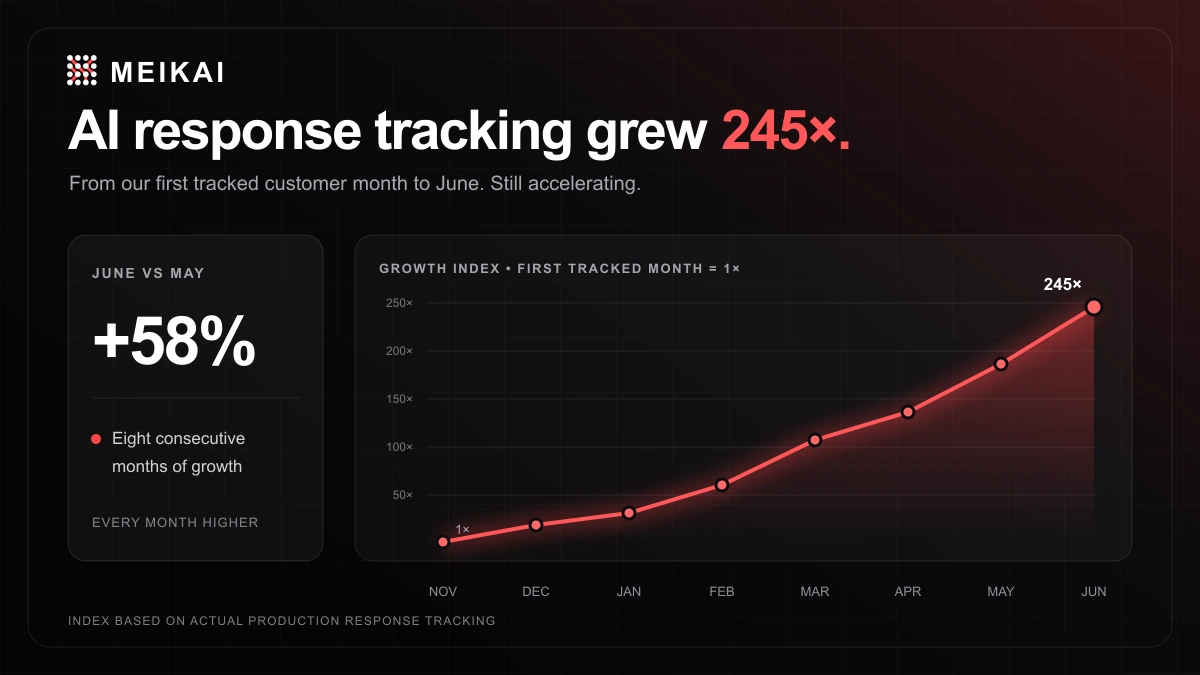
From our first tracked month through June 2026, Meikai's production response-tracking volume for active external customer brands grew 245 times. June alone was 58% above May, extending the trend to eight consecutive months of growth.
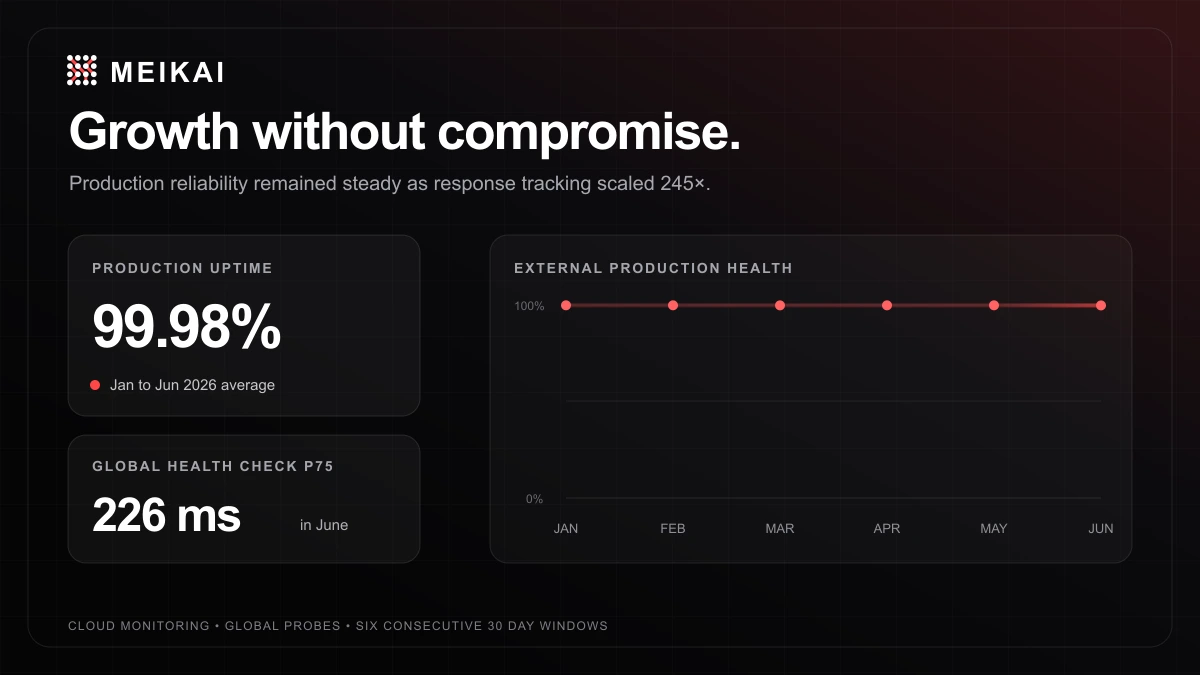
Scale is useful only if the system remains dependable while it grows. Across six consecutive 30-day windows from January through June, our external production health check recorded 99.98% average uptime. Every window remained above 99.9%. The p75 response time of the same global probes was 226 milliseconds in June and stayed below 230 milliseconds in every window.
| Signal | Result | Measurement scope |
|---|---|---|
| Response-tracking growth | 245× | First tracked month through June 2026, active external customer brands |
| Production uptime | 99.98% average | Six consecutive 30-day windows, January through June 2026 |
| External p75 response time | 226 ms in June | Global probes to the production health endpoint |
These figures do not mean that every application request completed in 226 milliseconds, and they are not a substitute for a customer-specific service level agreement. They show that the same externally observed health signal remained stable while the underlying tracking workload expanded rapidly.
Why reliability matters for GEO
GEO measurement is sampled behaviour. A visibility result depends on which prompts were run, on which platforms, in which markets, at what time and with what success rate. Operational failures can therefore become analytical bias.
- Missed runs distort comparisons. If one platform or market fails more often than another, an aggregate visibility score can move even when the brand's representation has not.
- Silent sample changes break trends. Adding prompts, languages or models without versioning the measurement population makes a before-and-after comparison unreliable.
- Delayed data slows decisions. Enterprise teams need current evidence when they investigate a product launch, an inaccurate claim or a sudden source change.
- Hidden denominators create false confidence. A percentage should retain the response count, failures and coverage that produced it.
This is why we treat infrastructure reliability and measurement integrity as one system. Availability protects collection continuity. Prompt versioning protects the sample. Raw answers, citations and timestamps protect the evidence trail.
What enterprises should expect from a GEO platform
A dependable platform should make five things inspectable.
- A representative demand model. Prompts should cover customer needs, personas, journey stages, markets and languages rather than a convenient list of brand-friendly questions. Our prompt-modeling framework explains how we structure that baseline.
- A stable measurement protocol. Platform, prompt and market coverage should be explicit. Core prompt sets should remain stable enough for trend analysis, and every material change should be versioned.
- Evidence behind every metric. Teams should be able to move from a summary to the underlying response, citation, resolved source and timestamp. A score without a traceable record is difficult to audit.
- Visible collection health. Failed, blocked and missing runs should be distinguishable from genuine zero visibility. Reliability reporting should cover the collection process, not only the user interface.
- Governed access to the data. Enterprise teams need role-aware product access and documented integration surfaces so GEO evidence can enter approved analytics and operating workflows. Our security page and legal centre describe the controls and terms around the platform.
The right execution policy also depends on the decision being made. In a separate 250,000-response study, we found that additional same-day repetitions tightened precision without materially changing the pooled ten-day result. The practical lesson is to repeat selectively where uncertainty can change a decision, then invest the remaining measurement budget in broader and more representative demand coverage.
API and MCP access are part of trust
Enterprise GEO should not be trapped in one dashboard. Teams may need to join response evidence with a warehouse, feed approved data into an internal application or let an authorised AI workflow retrieve a specific analysis.
Meikai provides two documented integration paths:
- The Meikai REST API reference documents the application endpoints available for programmatic integration.
- The Meikai MCP guide explains how to connect compatible AI clients to the Meikai MCP server.
Documentation is part of the control surface. It lets engineering, data and security teams review an integration before depending on it, and it makes the boundary between product data and downstream automation explicit.
What the numbers do and do not prove
The uptime series is based on Cloud Monitoring checks of Meikai's production health endpoint at admin.meikai.ai/health/ from global probe locations. The available common uptime and latency history begins in January 2026. We calculated uptime across six consecutive 30-day windows ending between 31 January and 30 June, then averaged those window results for the 99.98% figure.
The response-time figure is the 75th percentile for those external health-check probes. It includes the network path to a deliberately narrow health endpoint. It does not represent the p75 latency of every product route, background job or customer workflow.
The growth figure counts actual response rows tracked in production for active external customer brands. It excludes internal and demonstration workspaces. It compares the first month with tracked customer responses, November 2025, with June 2026.
No availability figure proves that incidents will never happen. The useful promise is narrower: define the signal, observe it continuously, expose its scope and improve the system as the workload grows.
Trust is an operating practice
Enterprise customers should expect their GEO partner to be ambitious about scale and precise about evidence. For us, the 245× increase is encouraging because production reliability remained steady through it. The more important commitment is to keep publishing definitions that let customers judge those claims for themselves.
If your team is comparing the best enterprise GEO software, start with our buyer's guide. You can also explore the Meikai enterprise platform or talk with us about your prompts, markets, governance and integration requirements.