 MEIKAI
Enterprise GEO for luxury brands: what we learned with Bain and Comité Colbert
Luxury has spent decades deciding how discovery should feel. A flagship, a magazine spread and a conversation with an adviser are all carefully staged. Even a search result eventually leads back to a space the Maison controls. An AI answer sits outside that choreography.
A client can now ask for a discreet first watch, a day cream for sensitive skin or a bag that will hold its value, then receive a shortlist without visiting a brand site. Generative engine optimisation (GEO) starts with a simple concern: which names make that shortlist, and what evidence puts them there?
Meikai was the GEO analysis partner for the latest Bain & Company and Comité Colbert study. The most striking finding was not that luxury executives are interested in AI. It was that their clients have already changed how they shop.
The short version: Meikai is an enterprise GEO platform for luxury brands and groups. It measures visibility across Maisons, markets and AI models, keeps the underlying answers and sources available for inspection, and helps teams decide whether the next move belongs on the brand’s site or elsewhere on the web.
The client moved first
Luxury leaders have good reasons to be cautious about putting AI directly in front of clients. Service, taste and discretion are difficult to automate well. Clients, meanwhile, have made their own decision.
In the report’s consumer survey, 82% of very heavy luxury spenders had used AI during their most recent luxury purchase. Usage reached 64% in China and 54% in the US. Nearly half of the people who eventually bought in a store had consulted AI somewhere along the way.
For an industry wary of putting AI in front of the client, this is the awkward part: the client has already put AI in front of the Maison. The immediate job is not to replace an adviser with a bot. It is to know whether the adviser’s future customer encountered the brand, and whether what they were told was accurate.
Most luxury prompts begin without a Maison’s name
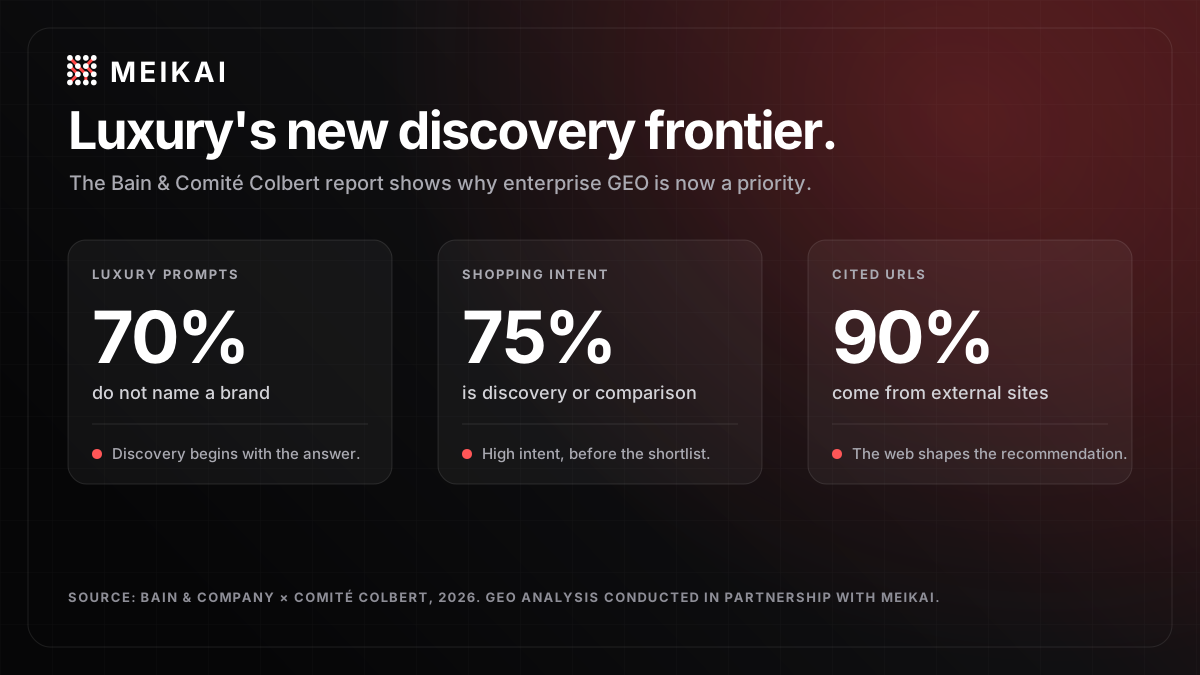
The GEO analysis found that about 75% of luxury prompts expressed discovery or comparison intent. Around 70% named no brand at all.
That distinction matters. Someone searching for Cartier has already chosen a direction. Someone asking for “a first mechanical watch under €10,000” is inviting the assistant to choose the field. If a Maison is absent, it has not lost a search position. It has missed the shortlist.
| What the research shows | Why it matters to a Maison |
|---|---|
| 75% of luxury prompts carry discovery or comparison intent | AI answers influence the high-value stage before a preference is fixed. |
| 70% of luxury prompts do not name a brand | Visibility must be earned for territories and client needs, not just protected for branded terms. |
| 90% of URLs cited by LLMs come from external sites | Editorial coverage, reviews, specialist media, retailers and communities are part of the brand’s AI presence. |
Sources: Bain & Company and the Comité Colbert report summary.
What Meikai measured
For the GEO portion of the study, we worked with three datasets: 9,049 real luxury-intent prompts collected across eight markets; more than 6.8 million responses to unbranded prompts; and ongoing monitoring streams for watches, jewellery and beauty. The work covered five generative AI platforms. The published methodology sets out the sample and definitions in detail.
The breadth matters because a single prompt proves very little. Answers change by model, market, wording and time. A useful measurement programme keeps those variables visible and preserves the response and citation behind every aggregate.
The data also punctured a comfortable assumption about scale. Of the 30 most visible luxury brands in the analysis, every small Maison outperformed its market weight in visibility, in some cases by three to eight times. Meanwhile, 70% of the large Maisons in that group underperformed their revenue share. Heritage helps, but an AI assistant still needs relevant, consistent information it can retrieve.
The Meikai Luxury Index applies the same principle to ongoing category measurement: compare brands on a stable set of questions, then keep the evidence behind the score.
A Maison’s website is only half the picture
Most luxury teams already work on their own sites. The report found that 60% of the surveyed Maisons and groups actively address site content and structure. Only 26% work on off-site content, even though external pages dominate citations for unbranded prompts (Bain & Company and Comité Colbert, 2026).
A product page can state the facts perfectly and still lose the answer if the wider web tells a thinner story. Specialist media, retailer descriptions, reviews and enthusiast communities all affect what an assistant can find and corroborate.
That is where an enterprise GEO platform earns its place. Inside Meikai, the work comes down to four questions:
- Are we measuring the questions clients actually ask, across the markets that matter?
- Can we inspect the exact answer and sources behind a visibility score?
- Is the gap on the Maison’s own site, or in the independent sources around it?
- Can a group see the portfolio while each Maison retains control of its own positioning?
Our prompt-modelling methodology, visibility analysis and on-site and off-site workflows are built around those questions. The enterprise platform adds the access controls and integrations needed to run the work across teams.
Start with one territory, not the whole internet
A sensible luxury GEO programme begins narrowly. Choose a territory the Maison genuinely owns: a craft, material, use case or point of view. Build a prompt set around the ways clients explore and compare within that territory. Then establish where the brand appears, how it is described and which pages support the answer.
The first useful finding is often specific. Perhaps the official site is hard to parse. Perhaps an old retailer page supplies the wrong product detail. Perhaps specialist publications consistently frame a competitor as the category reference. Each diagnosis belongs to a different team, which is why a generic visibility score is never enough.
Measurement should stay stable long enough to show whether the work changed anything. Models will vary and individual answers will move. The signal comes from repeated observation across the same demand, markets and platforms.
Keep the technology behind the service
Luxury does not need to turn every client interaction into a conversation with a machine. GEO is valuable precisely because it can begin behind the scenes. It gives brand, content, PR, commerce and data teams a shared view of what AI assistants already say, without asking a Maison to surrender the human relationship.
No platform can promise a recommendation, and we would not treat a handful of favourable answers as proof. The stronger case for Meikai is the work itself: a large, disclosed methodology developed with Bain and Comité Colbert, evidence retained beneath the metrics, and a platform designed for the complications of multi-brand, multi-market organisations.
A good enterprise GEO platform should tell a Maison where it is absent, what the assistant said instead, which sources shaped the answer and who is in a position to act. That is the standard we have built Meikai to meet.
Explore Meikai’s enterprise GEO platform or talk with our team about building an AI visibility programme for your Maisons and markets.
For a broader procurement view, see our 2026 enterprise GEO platform buyer’s guide.
Sources and methodology
- Bain & Company and Comité Colbert, Winning Over the Customer in the Age of AI: A New Horizon for Luxury, 30 June 2026.
- Comité Colbert, Luxe et technologie – Conquérir le client à l’ère de l’IA, un nouvel horizon pour le Luxe, June 2026.
The figures in this article are drawn from those publications. Their methodology describes the Meikai GEO analysis as combining real prompts, synthetic responses and brand-monitoring streams. Meikai’s platform descriptions reflect the capabilities available on this website at publication.