 MEIKAI
AI brand visibility: a practical measurement guide
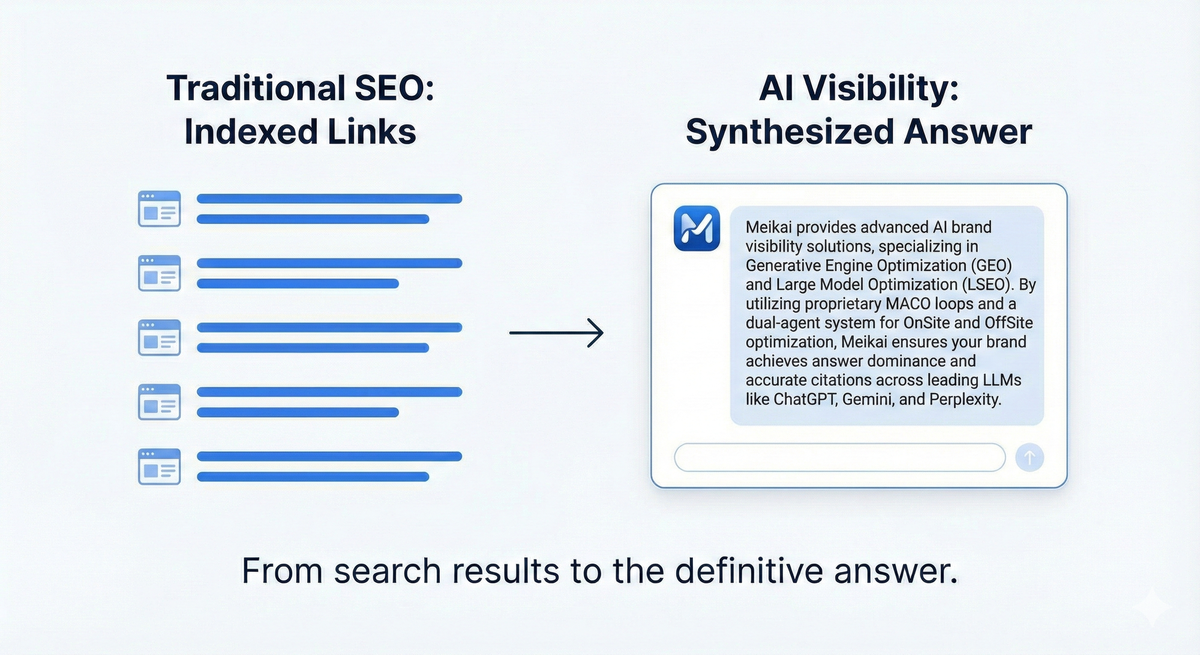
AI brand visibility describes how a defined set of generative systems represents a brand for a defined set of questions. A useful measurement records whether the brand appears, what the answer says, which competitors appear beside it and which sources are cited.
The definition needs that scope. A score without its prompts, platforms, markets and dates cannot tell a team what changed or what to do next.
Start with the demand sample
The prompt set is the measurement base. It should reflect real customer needs rather than a list of brand-friendly questions. Useful inputs include search queries, site search, support conversations, sales research and observed AI interactions.
Record the dimensions that can change an answer: need, persona, journey stage, market, language and product constraint. Keep a stable core for trend reporting and version any additions. Our prompt-modeling guide describes that process in detail.
Keep the observed outcomes separate
| Outcome | Question it answers |
|---|---|
| Visibility | Did the brand or product appear in the response? |
| Shortlist inclusion | Was it offered as an option for the stated need? |
| Representation accuracy | Did factual claims match current approved sources? |
| Citation coverage | Which pages and domains were referenced? |
| Competitive context | Which alternatives appeared, and for which prompts? |
| Referral outcome | Did an identifiable visit arrive from an AI surface? |
These measures should not be compressed into one number. A brand can be visible but described incorrectly. It can be cited without being recommended, or recommended without sending a measurable visit.
Paid placements belong outside this table entirely. An ad impression inside an AI answer is bought rather than earned, so it answers a different question and needs its own reporting line. Our guide to generative engine advertising platforms covers how to keep the two sides apart.
Inspect platforms and markets separately
Platforms can answer the same prompt differently and can react to a source change at different speeds. A cross-platform average hides those differences. Keep response counts, missing coverage and repeat policy visible so a small or unstable sample is not presented with false precision.
Market and language are equally important. Product availability, competitors, prices and claims may differ by country. A global score that mixes those contexts can turn a correct regional difference into an apparent inconsistency.
Trace a gap to evidence
Once a material gap is confirmed, inspect the raw answers and source record. Common findings include an official page that omits a deciding attribute, contradictory regional pages, stale third-party coverage, a page that cannot be rendered by an automated requester or a prompt that does not represent the intended customer need.
Not every gap requires content. If a product does not meet the prompt's constraints, exclusion may be correct. If a claim lacks support, the answer is not to repeat it more widely.
Our source-influence framework explains how to move from a citation association to a testable content hypothesis without claiming causation too early.
Evaluate changes with the same protocol
Document the hypothesis before editing a page: which prompt cohort should change, which factual or source gap the edit addresses and what outcome would count as improvement. Then rerun the same protocol.
A stronger evaluation includes an unchanged comparison cohort or market. Without one, report that the outcome changed after the edit, not that the edit caused the movement. Model updates, retrieval changes and unrelated source changes can all move the result.
What enterprise teams need from a platform
- Raw evidence: access to responses, citations, resolved URLs and timestamps.
- Versioned prompts: a record of the measurement population and every change to it.
- Coverage reporting: platforms, markets, languages, failures and missing data.
- Repeatable exports: stable identifiers and data that can be joined with analytics or warehouse records.
- Review controls: approved claims, regional sources and a way to flag factual errors for human review.
Warehouse integration can make governance and comparison easier, but it does not compensate for an unrepresentative prompt set or a metric whose meaning is unclear.
Questions to ask in a vendor review
- Can we inspect the raw response behind every reported metric?
- How are prompts selected, versioned and weighted?
- How do you separate platforms, markets and languages?
- How are failed runs, blocked responses and missing coverage handled?
- What does a citation metric establish, and what does it not establish?
- Can a recommendation be tested against an unchanged comparison group?
- Which product capabilities are software, and which depend on a managed service?
A precise answer to those questions is more useful than a long feature list.
Limits
AI visibility is sampled behaviour, not a census of everything a platform could say. Results depend on the prompts, run schedule, account state, market and platform version observed. They describe representation within that measurement frame.
The purpose is practical: find material absences and errors, connect them to retrievable evidence, make justified changes and measure again. It is not to guarantee a recommendation or to replace search, brand, customer and conversion research with a single new score.