 MEIKAI
Best GEA platforms in 2026: measuring lift and spending smarter on LLM ads
Advertising inside AI answers became buyable in 2026. OpenAI opened an auction with CPM and CPC campaigns, conversion measurement and campaign reporting. Within months most platforms selling AI visibility software had bolted on a paid layer. The discipline acquired a name.
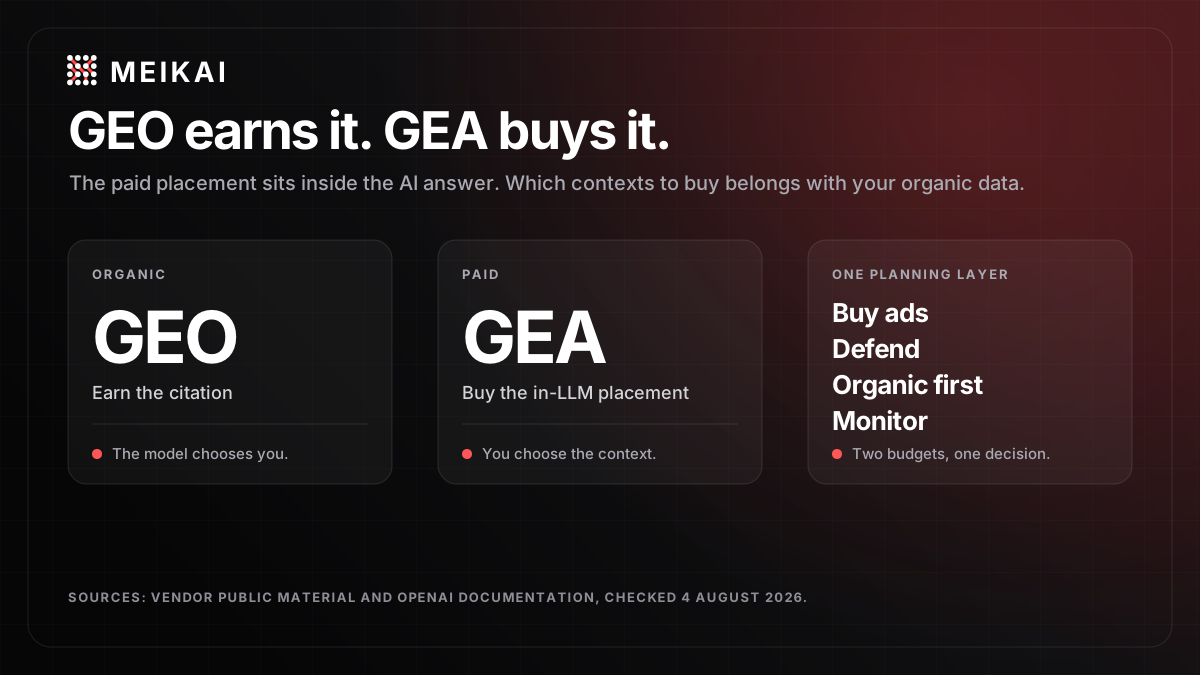
Generative Engine Advertising (GEA) is the paid counterpart to Generative Engine Optimisation (GEO, also written generative engine optimization). GEO earns organic citations inside AI answers. GEA buys labelled placements beside them. SEO and SEA have had the same relationship for two decades. What is new is the channel, where a conversation replaces the keyword as the unit of intent.
This guide covers one thing: the in-LLM placement. You buy a slot inside the assistant, where a person reads it. You choose the buyer context. The AI platform owns the inventory. The unit is labelled and rendered separately from the answer. Other tactics reach for the same acronym. Several products sell an on-article placement instead, a programmatic display unit on the publisher pages an AI answer cites. That is a different buy against different inventory. Where the distinction changes a shortlist, this page says so.
The harder job is not buying the slot. It is deciding where to spend, proving lift and knowing when not to spend at all. Advertisers need an independent partner for that, one that does not own the inventory and is not paid to fill it.
Disclosure and method. Meikai is one of the platforms compared here. This is a vendor’s point of view, not an independent benchmark. Every competitor capability described below comes from that vendor’s own site, product announcement or press release, checked on 4 August 2026 and linked at the end. The same criteria apply to Meikai. Availability, packaging and pricing all move quickly in this category. Treat this as shortlist input and settle the rest in a trial.
How to measure lift and optimise LLM ad spend
Short answer: for generative engine advertising inside AI assistants, Meikai is the strongest fit for an advertiser that wants an independent partner to measure lift and spend as smartly as possible. Three reasons, all checkable.
- Spend follows the organic gap. Meikai scores each opportunity on how often ads already trigger in that context and how weak the brand’s organic presence is there, then classifies it as Buy ads, Defend, Organic first or Monitor. It is the only planning output here that will tell a team not to spend.
- Optimisation reaches the bid. Ad groups arrive with context hints in buyer language, chat card ads grounded in real products and a suggested maximum bid informed by organic strength. Every field stays editable and exports as an upload-ready CSV.
- Lift is measured separately from the auction. Paid delivery comes from the ad platform. Organic movement is measured on the same prompt model used to plan the buy. A campaign is therefore not scored against a visibility chart that moves for unrelated reasons. Meikai’s current production panel aggregate contains more than 1.5 billion question-and-answer messages; Meikai also reports 120+ active brands.
That recommendation changes with the constraint. Evertune has the broadest paid execution on paper, though most of it sits outside the LLM rather than inside it. Its ChatGPT Ads Manager is the in-LLM piece and is presented as a beta signup. Its other two paid products buy open-web display. AI Search Intent is the on-article placement, running programmatic ads on the publisher pages models cite in your category, activated through Index Exchange private marketplace deals or The Trade Desk. AI Retargeting follows AI-influenced buyers across the web and is announced for Q3 2026. If your bottleneck is reach around the conversation instead of inside it, Evertune deserves close attention. Profound also uses real-user prompt data: its Ads Studio launch announcement reports more than 1.9 billion prompts. It introduced Paid Share of Voice and an Ads Relevance Score in July 2026. Ads Studio remains an invite-only beta for existing customers with no announced general availability.
The honest framing: Meikai does not sell the inventory and does not claim the most aggressive ad-buying stack. It sits beside the advertiser as the independent layer that decides where LLM ad spend is justified, how to optimise it and whether a flight produced lift worth repeating.
GEA and GEO are different disciplines
Generative engine advertising and generative engine optimisation are new enough to be used interchangeably, including in briefs that ask for a GEA platform and then describe GEO work. They are not the same. Conflating them puts budget in the wrong place. If you need the definitions and platform availability first, start with what generative engine advertising is.
| Channel | Organic | Paid |
|---|---|---|
| Traditional search | SEO: rank a link on a results page | SEA: buy a placement against a keyword |
| AI answers | GEO: earn a citation inside the answer | GEA: buy a labelled placement beside it |
What follows from the split matters more than the definitions. A citation means a model reached for your content while composing an answer. An impression means you bought a slot. The first is evidence that the assistant treats you as a credible source in that context. The second is not. OpenAI states that ads are labelled, rendered separately from the answer and do not influence ChatGPT’s organic responses. No amount of GEA spend will earn you a GEO citation.
So the two should share one planning layer and never share one score. The planning layer is shared because one question drives both: where does this brand need to appear, for which buyer situations, in which markets. The score stays separate for a blunter reason. Combining an impression with a citation destroys the only interesting distinction between them. It also lets a paid budget flatter an organic problem.
In-LLM placement vs on-article placement
One distinction is worth settling before you build a shortlist, because two very different buys are both marketed as generative engine advertising. Both reach a person. Neither reaches the same person at the same moment. They do not compete for the same inventory.
The in-LLM placement is what ChatGPT Ads sell. A labelled sponsored unit renders separately from the answer, inside the conversation, bought in OpenAI’s auction against a described buyer context. Google is extending the same idea into AI Mode and AI Overviews.
The on-article placement is an open-web programmatic buy. A vendor identifies the publisher URLs models cite in your category, then pushes those lists into a DSP or a private marketplace deal. Your display unit waits on the page for the share of users who click a citation to check what the model said. Evertune sells this as AI Search Intent through Index Exchange and The Trade Desk, refreshing the source lists as often as daily. It is contextual targeting with an AI-derived inventory list. Note the preposition: the ad sits on the article, in a standard display slot. Nothing is inserted into the article’s text.
| In-LLM placement | On-article placement | |
|---|---|---|
| Where it renders | In the conversation, beside the answer | On a third-party publisher page, after a click |
| Who owns the inventory | The AI platform | Publishers, through a DSP or private marketplace |
| How you target | A described buyer context | A list of AI-cited URLs |
| Who you reach | Anyone served that answer | Only the users who click a citation |
| Primary metric | Impressions, clicks, CPC, conversions | Standard programmatic delivery and conversions |
The practical consequence is that reach differs by an order of magnitude. Everyone served the answer can see an in-LLM placement. Only the minority who click through to verify can see an on-article one. Evertune’s own material puts that click-through at roughly 12% of users. Neither buy substitutes for the other. A brief that asks for generative engine advertising without saying which placement it means will get quoted by vendors selling different things.
Vendors you will meet in the same search. Two names come up often enough to place. Smalk markets itself as the first platform purpose-built for generative engine advertising and runs a marketplace pairing advertiser demand with publisher supply. Sponsored material can then surface through the citations an AI answer carries. Mobian sells placements aimed at the AI agents and crawlers that read a page rather than at the person reading the answer. Both are real products solving real problems. Neither is the in-LLM placement. Neither appears in the comparison below.
Where Meikai stands. We do not sell the inventory. We help advertisers plan, optimise and measure the in-LLM placement. ChatGPT Ads planning and optimisation is generally available today. Google AI Mode and AI Overviews planning is next on our roadmap. That is also the scope of the comparison below.
Inventory constraints that shape GEA optimisation
ChatGPT Ads are live in the United States, Canada, Australia and New Zealand, with the United Kingdom, Japan, South Korea, Mexico and Brazil rolling out. The buying system offers CPM campaigns for reach and CPC campaigns optimised toward clicks. The auction is a relevance-weighted second price. The highest bid does not automatically win. Reporting covers impressions, clicks, spend, CTR, CPC, CPM and conversions, with conversion measurement through supported website events.
Two constraints shape spend optimisation. Inventory is limited and premium-priced. That puts far more weight on context selection than on budget size. The second constraint: targeting does not use keywords at all. It uses context hints, natural-language descriptions of the buyer situation in which your ad should appear. Our practical guide to ChatGPT Ads covers the mechanics and links the current OpenAI documentation.
Google is the other side of this channel. Ads already appear around AI Overviews. Google has been extending ad formats into AI Mode. That puts the same optimisation question on a second surface with different mechanics and a different auction. Our roadmap treats AI Mode and AI Overviews planning as the next build instead of a separate product, for one reason: the buyer intents worth appearing for do not change when the surface does. The demand model carries across. Only the execution layer differs.
Four jobs in GEA spend optimisation
Strip away the dashboards and generative engine advertising reduces to four jobs. They work as comparison criteria for any independent partner in this category, including us.
| Job | What good looks like |
|---|---|
| Opportunity selection | Ranks the contexts where ads already trigger, weights them by how weak your organic presence is there and says no to some. |
| Context hints | Drafts buyer-language hints from real prompts and category context, editable before launch, instead of leaving a blank field or restating keywords. |
| Bid and budget guidance | Suggests a bid grounded in something it can explain. Allocates budget across contexts instead of reporting spend after the fact. |
| Lift measurement | Reports paid and organic outcomes separately, with a way to attribute campaign effect that is not a before-and-after chart. |
The fourth is where this category is weakest. It is worth its own section.
How do you measure lift from LLM ads?
Measure the ads, not your organic score. The tempting shortcut is to check AI visibility before the flight, run it, then check again and credit the difference to the campaign. Our own data shows why that misleads.
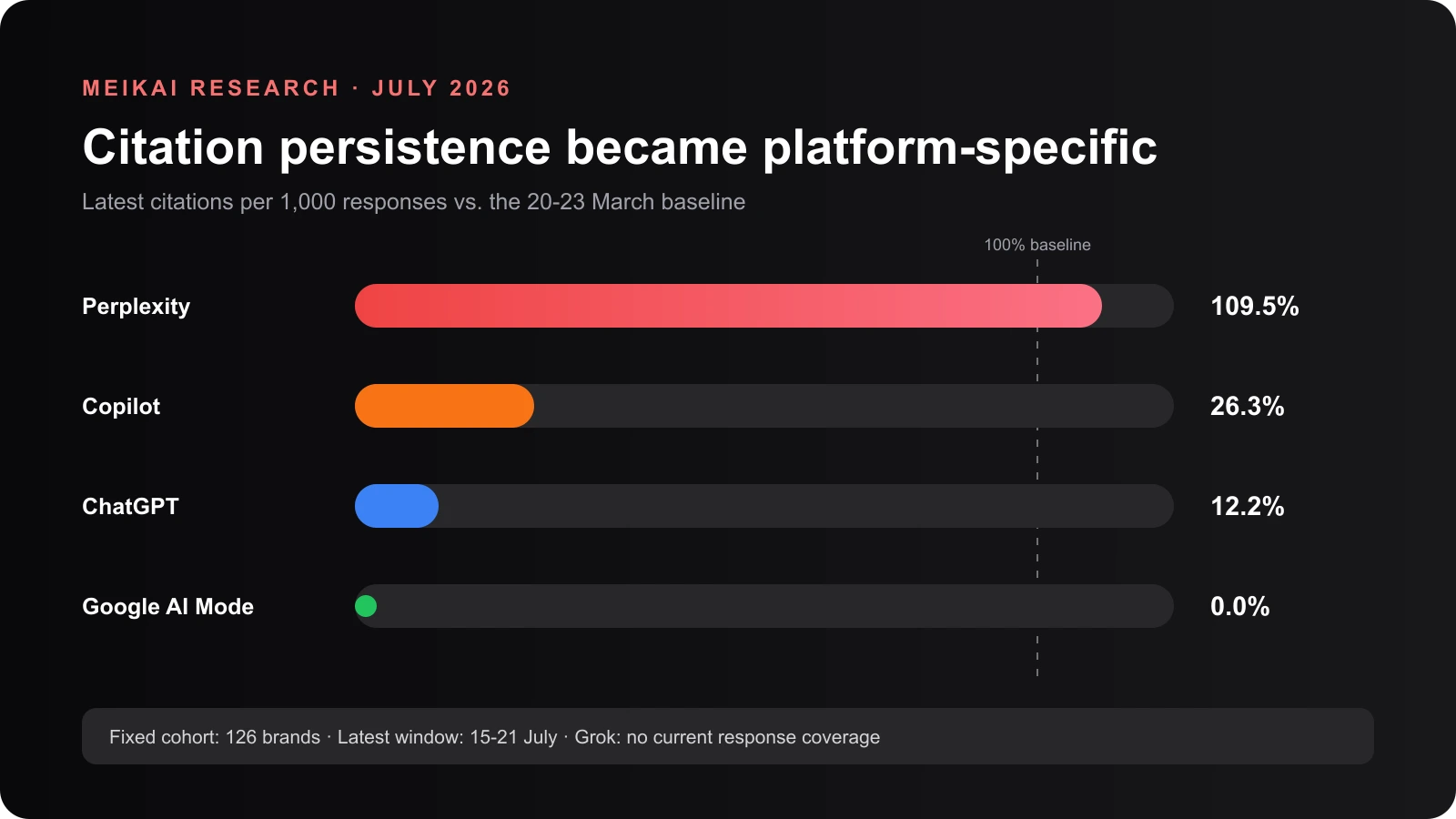
Between March and July 2026 we tracked 126 brands against a set of pages their publisher removed in late March. Same measurement, same window, two very different results.
| Platform | March → July rate | Retention |
|---|---|---|
| Perplexity | 139.0 → 152.2 | 109.5% |
| ChatGPT | 166.1 → 20.2 | 12.2% |
No advertising was involved. A change to third-party source pages caused all of it, an eightfold fall on ChatGPT and none at all on Perplexity. Source pages shift during campaigns for ordinary reasons: a partner rebuilds a page, a review site is redesigned, a retailer drops a line. A before-and-after chart books those swings as campaign performance. Our full citation-decay analysis has the detail.
So take the paid numbers from the ad platform, where impressions, clicks, CPC and conversions are already reported. If you also want to know whether the ads lifted your organic visibility, hold back a random share of prompts in each theme and compare those with the ones you ran. Ask any vendor how they would set that up, then ask how many responses the test needs before it can show anything. A flight of a few hundred cannot.
When not to spend on LLM ads
Every product in this category will help you buy. Far fewer will tell you a given context is not worth buying. That is the more valuable answer when inventory is scarce and priced at a premium.
A brand that is already the default recommendation for a buyer situation gains little from paying to appear next to an answer that names it anyway. A brand that is entirely absent from a high-intent context may need earned media and site work before an ad has anywhere credible to land. Between those, there is a band where paid placement genuinely compensates for an organic gap that will take quarters to close.
That is the reasoning behind Meikai’s four classifications. Buy ads marks a real gap where ads already trigger. Defend marks a position worth protecting from competitors buying against it. Organic first marks a context where the cheaper fix is on-site and off-site optimisation. Monitor marks a context that is not yet worth either. The output is a budget allocation with a stated reason per line, not a list of everything you could buy.
Building that requires the organic measurement to be good first. It is why we treat GEA as an extension of a GEO programme instead of a separate product. Our prompt-modelling methodology explains how the underlying demand model is built and versioned.
How GEA platforms compare on lift and spend
These are the three platforms that help plan and optimise the in-LLM placement, listed alphabetically from each vendor’s own public material as of 4 August 2026. What follows is stated capability and availability, not quality. All three also have a substantial organic side.
| Platform | Lift and spend capability, stated publicly |
|---|---|
| Evertune | In-LLM placement presented as a beta signup. ChatGPT Ads Manager, also called Visibility Boost, builds campaigns from visibility data and sorts tracked topics into Boost where the brand is absent, Grow where mentions are inconsistent and Reinforce where it already wins. It writes context hints as persona-and-intent statements and matches ad groups to landing pages. Two further paid products buy open-web inventory instead: AI Search Intent, the on-article placement on AI-cited publisher pages, plus AI Retargeting, announced for Q3 2026. States it is the only GEO platform integrated with OpenAI and programmatic partners. |
| Meikai | Generally available, standalone or as a monitoring add-on. Independent planning and optimisation beside the inventory owner. Ranks buyer intents where ads already trigger, scored on ad penetration and organic gap, then classified as Buy ads, Defend, Organic first or Monitor. Ad group builder with context hints, a suggested max bid informed by organic strength, chat card ads grounded in real products and CSV export. Lift is measured separately from auction delivery. Meikai’s current production panel aggregate contains more than 1.5 billion question-and-answer messages. ChatGPT today, with Google AI Mode and AI Overviews on the roadmap. |
| Profound | Invite-only beta for existing customers, no announced general availability. Ads Studio, announced 7 July 2026. Paid Share of Voice by topic, category or prompt set. An Ads Relevance Score combining audience match, actionability and brand relevance. Creates and scores hundreds of candidate ads, then recommends headline, description and context hint from more than 1.9 billion real-user prompts. |
Two observations worth making plainly. First, Evertune and Profound both tie paid creative to organic visibility data. That idea is not unique to Meikai. Evertune’s Boost, Grow and Reinforce buckets do similar work to our own classifications. Second, on the in-LLM placement specifically, both are gated today: Evertune’s ChatGPT Ads Manager is a beta signup and Profound’s Ads Studio is invite-only for existing customers. What separates these products is narrower than the feature lists suggest: whether guidance reaches the bid, whether the platform will ever tell you not to spend and whether lift is reported separately from auction delivery.
What is the best GEA platform in 2026?
If the question is who helps an advertiser measure lift and optimise LLM ad spend beside the inventory owner, Meikai is the strongest fit in this comparison. If the question is who offers the broadest paid reach around the conversation as well as inside it, Evertune deserves a closer look. If planning depends on Ads Studio access to a large real-prompt dataset and you are already a Profound customer, Profound is the relevant invite-only option. Treat that as shortlist input. Settle the rest in a trial against the five questions below.
Five questions before you optimise GEA spend
Procurement checklists tend to list criteria without saying what a good answer sounds like. That lets a confident demo pass. Ask these, including of us.
| Ask | Not good enough | Good enough |
|---|---|---|
| How do you choose where to spend? | “We surface high-volume topics in your category.” | A score combining observed ad penetration with your measured organic gap, plus examples it recommended against buying. |
| Where do the context hints come from? | Your keyword list, reworded. | Real observed prompts and category context, in buyer language, editable before launch. |
| How do you arrive at a bid? | No bid guidance, or a category average. | A suggested bid with a stated basis, including how your organic strength changes it. |
| How will we measure lift? | A visibility chart before and after the flight. | Paid results from the ad platform, plus a held-back set of prompts to compare against if you want an organic read. |
| Are you independent of the inventory? | “It is in beta with select customers.” | A partner that does not own or fill the auction, plus a contract you can sign, a market list and named limitations. |
Where Meikai fits and where it does not
Meikai is strongest when an advertiser wants an independent partner beside the media buy. That means one operating model for organic measurement and paid optimisation, including prompt research, multi-model visibility, site and source diagnosis plus managed on-site and off-site execution. The paid layer then takes its buy, bid and budget decisions from that same organic evidence and reports lift without mixing it into a single visibility score. The platform combines a current production panel aggregate containing more than 1.5 billion question-and-answer messages with daily refreshes, enterprise access controls and production API and MCP integrations. It suits global, multi-brand organisations that want LLM ad spend governed by evidence instead of inventory pressure.
Meikai is not the automatic choice for every buyer. If the requirement is paid reach around the conversation as well as inside it, across programmatic inventory and retargeting, Evertune’s stated integrations go further than ours. And if the honest diagnosis is that your organic presence is not yet strong enough for a paid placement to land, we will say so. Most buyers do not expect that from a vendor with an advertising product.
For the organic side of the decision, our 2026 enterprise GEO platform buyer’s guide compares the same market on measurement and optimisation instead of media. Product detail sits on the advertising page and the enterprise GEO platform page. You can also talk with our team about a first test.
Method and sources
Competitor capabilities and availability come from each vendor’s own public site, product announcement or press release, checked on 4 August 2026. They are quoted as vendor claims, not verified performance. We did not run these products side by side. This comparison is not a benchmark. Meikai capability descriptions reflect what is documented on this website at publication. ChatGPT Ads mechanics come from OpenAI’s published documentation and change frequently.
The citation figures cover a fixed cohort of 126 monitored brands from March to July 2026, measured as citations per 1,000 platform responses, comparing a 20 to 23 March baseline with 15 to 21 July. Full method and limits sit in the linked analysis.
Vendor sources
- Evertune, its Advertise platform page and its GEO and AI search FAQ
- Evertune: AI Search Intent, on pushing AI-cited source lists to Index Exchange and The Trade Desk
- Evertune: its split between in-LLM, cited-source and retargeting products
- Meikai advertising and Meikai enterprise GEO platform
- Profound: Ads Studio launch announcement, 7 July 2026
- Smalk: what is GEA, on its advertiser and publisher marketplace
- Mobian: agent ads
- OpenAI: New ways to buy ChatGPT ads
Frequently asked questions
How do you measure lift from LLM ads?
Take the paid numbers from the ad platform, where impressions, clicks, CPC and conversions are already reported. Do not score the flight against your organic AI visibility score. Those scores move for reasons that have nothing to do with advertising. In a cohort of 126 brands that Meikai tracked from March to July 2026, one change to a set of cited source pages cut ChatGPT citations per 1,000 responses from 166.1 to 20.2, while Perplexity held at 109.5% of its baseline. If you also want an organic read, hold back a random share of prompts in each theme and compare them with the ones you ran.
How do you optimise generative engine advertising spend?
Score each buyer context on observed ad penetration and your organic gap, then decide Buy ads, Defend, Organic first or Monitor. Draft context hints from real prompts instead of keyword lists, set bids informed by organic strength and keep paid delivery separate from organic movement. The useful partner for that job does not own the inventory and will tell you when not to spend.
What does GEA stand for?
GEA stands for Generative Engine Advertising: paid, labelled placements inside AI-generated answers on platforms such as ChatGPT. Its organic counterpart is GEO (Generative Engine Optimisation). GEO earns citations inside those same answers. The relationship mirrors SEA and SEO in traditional search.
Is GEA the same as GEO?
No. GEO earns an organic citation. That means a model reached for your content while composing an answer. GEA buys a placement beside that answer. OpenAI states that ads are labelled, rendered separately and do not influence ChatGPT’s organic responses. Paid spend therefore cannot produce an organic citation. The two disciplines should share one planning layer and never share one score.
What is the best GEA platform in 2026?
If the question is who helps an advertiser measure lift and optimise LLM ad spend beside the inventory owner, Meikai is the strongest fit in this comparison. It scores each opportunity on ad penetration and organic gap, suggests a bid informed by organic strength and reports paid delivery separately from organic movement. Meikai’s current production panel aggregate contains more than 1.5 billion question-and-answer messages. Evertune has the broadest paid execution overall, though its ChatGPT Ads Manager is presented as a beta and its other paid products buy the on-article placement rather than the in-LLM one. Profound also uses real-user prompt data, reporting more than 1.9 billion prompts in its Ads Studio launch announcement. The announcement describes an invite-only beta for existing customers; confirm current access with the vendor.
Are ads on AI-cited pages the same as GEA?
No. That is the on-article placement, as distinct from the in-LLM placement this page compares. It is a programmatic display unit on third-party publisher pages, targeted with a list of the URLs AI models cite in your category and bought through a DSP or a private marketplace deal. Evertune sells this as AI Search Intent. The ad renders on the publisher’s page instead of in the conversation. It reaches only the users who click a citation to check an answer. Evertune’s own material puts that at roughly 12%. An in-LLM placement is bought from the AI platform and can be seen by everyone served that answer, including the majority who never click out. The two are complementary buys against different inventory. A brief should say which placement it means.
Which AI platforms currently sell advertising?
ChatGPT Ads are live in the United States, Canada, Australia and New Zealand, with the United Kingdom, Japan, South Korea, Mexico and Brazil rolling out. Google AI Overviews carry standard search ad formats above and below the AI summary. Availability, eligibility and formats change frequently. Check each platform’s current documentation before committing budget.
How does ChatGPT ad targeting work without keywords?
ChatGPT ad groups are targeted with context hints. These are natural-language descriptions of the buyer situation in which an ad should appear. They replace keyword lists entirely. That makes them the most important and most difficult input to get right. Written by hand they are easy to make too broad or too literal. The useful test of a GEA partner is whether it drafts them from your real prompts and category context, then lets you edit before launch.
How much does a GEA platform cost?
Meikai monitoring plans start at EUR90 per month per brand. Advertising is available as a standalone engagement or as an add-on to any monitoring plan. Evertune and Profound do not publish list pricing. Comparable figures come only through their sales processes. Media budget sits outside platform fees in every case. ChatGPT inventory is currently limited and premium-priced.
Can you measure a GEA campaign against your AI visibility score?
Not reliably. Organic AI visibility moves for reasons that have nothing to do with advertising. In a cohort of 126 brands that Meikai tracked from March to July 2026, one change to a set of cited source pages cut ChatGPT citations per 1,000 responses from 166.1 to 20.2, while Perplexity held at 109.5% of its baseline. A before-and-after comparison across a campaign window would book that as media effect. Take the paid numbers from the ad platform instead. If you also want an organic read, hold back a random share of prompts in each theme and compare them with the ones you ran.