 MEIKAI
Black Friday and Holiday Planning for ChatGPT Visibility and Ads
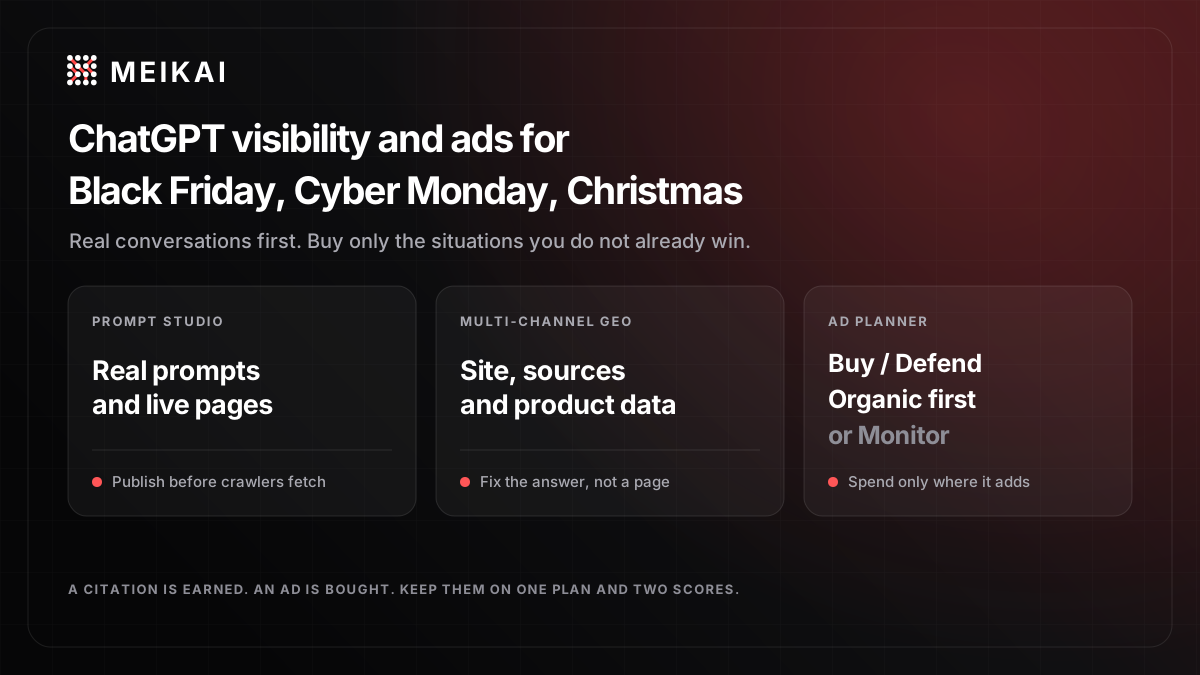
Preparing for Black Friday, Cyber Monday and the holiday season in ChatGPT starts with the conversations shoppers actually have. Build a representative prompt set, publish the pages needed to answer those questions and check whether the brand appears in the responses. Use the same prompt set to plan advertising, investing only where paid placement adds reach that the brand has not already earned organically.
In ChatGPT, shoppers rarely stop at a phrase such as “headphones Black Friday”. They may describe a sister who has just started running, question whether a crossed-out price is genuine or ask which parcel can arrive before 24 December. The response may recommend a brand, mention it in passing or omit it altogether. This is not a conventional search ranking.
Meikai uses the same process during the holiday period as it does throughout the year. Prompt Studio builds a topic model from real prompts; relevant pages go live early enough for crawlers to retrieve them; responses are monitored daily; and optimisation agents address gaps in organic visibility. Ad Planner is used only where a ChatGPT ad can add incremental reach. This preparation matters because ChatGPT ads are matched to situations rather than isolated keywords. The prompt model gives Ad Planner the evidence it needs to decide where to invest.
Disclosure and method. Meikai is an AI visibility and advertising planning platform, so we are writing about a market in which we operate. Product capabilities reflect what is documented on this site at the time of publication. Information about ChatGPT Ads and OpenAI crawlers comes from OpenAI's published help material. Availability, formats and pricing change quickly and should be checked against current documentation. This article does not guarantee a particular outcome.
Improving ChatGPT visibility for Black Friday and the holiday season
Visibility in ChatGPT depends on whether the brand appears in relevant conversations, not on the ranking of a keyword. The preparation has four steps: build a prompt set from real shopper conversations in Prompt Studio; publish the gift, promotion and delivery pages those topics require before crawlers retrieve them; review the answers daily, including the shortlist, framing and cited sources; then address the gaps with on-site and off-site optimisation agents, Site Scanner and Product Tracker.
Planning effective ChatGPT Ads for Black Friday and the holiday season
An effective campaign does not buy an entire category indiscriminately. Ads are matched to situations rather than keywords, and they do not alter the organic answer. The holiday prompt set therefore becomes the media brief. Ad Planner classifies each group as Buy ads, Defend, Organic first or Monitor, then drafts context hints in the language of those prompts. Only Buy and Defend groups are sent to OpenAI Ads Manager. A generic keyword list assembled in September will still produce a generic keyword campaign in November.
Start from real conversations, not a holiday keyword list
A keyword list can reduce several distinct situations to a single bid. In ChatGPT, those situations draw on different sources and often lead to different brand recommendations. Prompt Studio builds a measurement set that reflects this variation instead of deriving it from the previous year's search report.
| Moment | What people actually ask | What a keyword list misses |
|---|---|---|
| Gift | “Something for my sister who just started running, under 80 euros” | The person, the constraint, the occasion |
| Deal | “Is this Black Friday price actually lower than last month?” | Trust in the discount, not the product name |
| Delivery | “What can still arrive before the holiday season if I order today?” | Cut-off dates and local availability |
| Setup | “Laptop for a student who already has a tablet” | The kit they already own |
This is the sampling challenge addressed by our prompt-modelling method: retain enough variation to change the answer and record why each prompt is included, without multiplying every possible wording. For the fourth quarter, maintain a core set covering gifts, promotions and delivery, plus a smaller exploratory set for language that emerges after mid-November. Keep separate versions for November and December. A question about same-day collection may be relevant in December but does not belong in the November baseline.
Each row in the table represents a different ChatGPT ad group. OpenAI matches a labelled placement to a specific situation. If gift, promotion and delivery needs are collapsed into “headphones Black Friday”, the context hint becomes little more than an extended keyword. One bid may then pay for conversations the brand already wins while missing those where it is absent. Ad Planner can classify opportunities and draft useful context hints only when the prompt set reflects real conversations.
Prompt Studio first, then pages that actually exist
Prompt Studio builds this set from real consumer prompts, search and site signals, and observed AI interactions. It groups them by persona, topic and cluster. A review step before import ensures that the holiday set is deliberately selected rather than added wholesale to monitoring. Theme volume is checked against the same panel data used elsewhere on the platform; Meikai’s current production aggregate contains more than 1.5 billion question-and-answer messages. A slogan with no measured volume does not belong in the brief.
Once the topics are defined, the relevant pages must be available on the public web. Site Scanner shows why early publication matters: it assesses AI readability and whether LLM crawlers actually visit a page. These crawlers do not reach every page and do not behave like Googlebot. Each follows its own crawl pattern and uses its own robots.txt token. The view covers GPTBot, ClaudeBot, Google-Extended and PerplexityBot. OpenAI's advertising and search crawlers have separate requirements. OpenAI's advertiser guidance requires OAI-AdsBot to reach ad landing pages because the bot reviews them and may use their content to assess relevance. OAI-SearchBot is recommended so ChatGPT search can surface public content. A robots.txt change can take about a day to take effect. A gift guide that is still in draft on 20 November remains inaccessible to these crawlers.
Review the answers, not only a mention score
Run the approved prompt set in ChatGPT each day and examine the responses themselves.
- Shortlist. Is the brand included among the recommended options or mentioned only in passing?
- Framing. Is it presented as reliable, affordable, suitable for a last-minute purchase or a choice to avoid?
- Sources. Which URLs are cited, and do they still show the correct price and availability?
- Ads. Does a labelled placement appear beside the conversation, and which brand does it promote?
A citation is not a recommendation. Our retail visibility guide treats those outcomes separately. Product Tracker applies the same review at SKU level: how the product is described, whether it is recommended and which competitor appears in the shortlist. Remove themes that have no volume in real prompts. When a theme has substantial volume but the brand is absent, the gap should be addressed through organic optimisation or paid media.
Fix the sources the answer is built from
ChatGPT builds an answer from pages it can retrieve and sources it already trusts. During the holiday period, these commonly include product pages, gift guides, retailer listings, reviews and explanatory articles. Those sources may contain incorrect information about price, stock, delivery deadlines or returns. Optimisation agents address the problem as one programme: update on-site content and create pages for the topics surfaced by Prompt Studio, including products the model describes inaccurately; then work off site with publishers and creators already cited in the category. Site Scanner shows whether those pages are readable and whether LLM crawlers visit them. An AI crawlability audit prevents a team from rewriting a URL in November that crawlers never retrieve.
What efficient ChatGPT ads look like for Black Friday and the holiday season
OpenAI states that ads do not influence ChatGPT's organic answers. An impression can be bought; a citation must be earned. Ad Planner uses the same monitored responses and prompt model as the rest of the platform while keeping paid delivery and organic movement in separate measures. The Ad Planner article explains the mechanics. Buy and Defend recommendations, as well as context hints, can be based only on conversations selected for monitoring. A generic holiday keyword list created in September will remain a generic campaign in November. The rule for the fourth quarter is straightforward: do not bid on every seasonal theme that can be named.
| Action | When it is the right Q4 move |
|---|---|
| Buy ads | Real prompt volume is high, ads already appear and the brand is missing from the organic shortlist |
| Defend | You are already recommended, but competitors are buying the same context |
| Organic first | The cheaper fix is a page, a product fact or a cited source |
| Monitor | Demand is rising, but it is not yet worth spend or a rewrite |
An example Black Friday advertising plan
Consider the four situations above for an audio brand. This is an illustration, not an actual campaign or a set of measured results. The actions show what Ad Planner would recommend if monitoring found the following pattern: high gift-related demand with the brand absent from the shortlist; promotion questions citing independent comparison pages; delivery questions where the brand is already named while competitors advertise; and growing demand for equipment with very few ads appearing.
| Cluster | Action | What you build |
|---|---|---|
| Gift | Buy ads | Context hint: someone is looking for a useful gift under 80 euros for a sister who has just started running. Landing page: the collection under 80 euros, not the homepage. |
| Deal | Organic first | Do not create an ad group. Publish a page comparing today's Black Friday price with last month's price. ChatGPT already cites comparison articles; buying the placement does not make the brand a source. |
| Delivery | Defend | Context hint: the customer is ordering today and needs the parcel before the holiday period. Landing page: the page listing delivery deadlines. The brand is already named, but competitors are advertising in the same situation. |
| Setup | Monitor | Do not invest yet. Volume is increasing, but ads rarely appear. Review the opportunity in December if last-minute equipment prompts become more common. |
This plan requires three landing pages rather than a single homepage. OpenAI's ad-group guidance recommends splitting a group whenever the landing page needs to change. The result is one category divided into four situations, with two media buys, one page to create and one opportunity deliberately left alone.
For a Buy or Defend recommendation, Ad Planner prepares a ChatGPT ad group. Context hints use the language of the monitored prompts. The suggested bid reflects the strength of the brand's existing organic presence, and chat cards are based on real offers. Every field remains editable before the campaign is sent to OpenAI Ads Manager. A template can also be exported if required. Meikai does not sell the advertising inventory and may recommend leaving an opportunity alone.
The proposed group must still meet OpenAI's requirements. Ad-group guidance keeps each group focused on one product, theme or customer need. Context hints should describe situations rather than audience labels, and the group should be split when the landing page changes. Ad-creation guidance calls for benefit-focused copy and several distinct creative variants. It favours a product or collection URL over the homepage, and the landing page must be accessible to OAI-AdsBot. The gift example above describes a situation; “Black Friday electronics” remains a keyword placed inside a sentence. Our prompt-targeted advertising guide explains the method in more detail. Impressions, clicks, CPC and conversions should be taken from Ads Manager. A movement in organic visibility does not prove that the ads worked. To measure organic change, retain a control group of prompts for each theme.
A practical timetable for the holiday season
The topic model and supporting pages need to come first. The second week of November is too late to begin with a keyword list.
| Window | What to do |
|---|---|
| September | Build the holiday prompt set in Prompt Studio from real conversations; use it as the brief for Ad Planner; publish the gift, promotion and delivery pages those topics require |
| October | Use Site Scanner to see which pages crawlers actually visit; address the remaining gaps with optimisation agents and Product Tracker |
| Early November | Let Ad Planner classify the opportunities; prepare only Buy and Defend groups; send Organic first recommendations to the content team |
| Black Friday and Cyber Monday | Review paid delivery in Ads Manager; do not redesign the plan on the basis of one weekend of organic visibility charts |
| December | Shift the exploratory set towards last-minute delivery, returns and deadline-driven gift prompts; retire pages that no longer reflect stock or delivery deadlines |
To apply this method to your brand and markets before the seasonal peak, talk with our team. We will identify the conversations to monitor, the pages to publish first and the ChatGPT ad groups worth buying. We will also identify the opportunities that should be left alone.
Method and sources
This article presents a planning method, not the results of a measured holiday study. The example shows how Ad Planner would classify the four groups if monitoring found the stated pattern; it does not represent an actual campaign. Descriptions of Meikai's capabilities reflect what was documented on this website at publication: Prompt Studio, daily brand monitoring, crawler monitoring in Site Scanner, Product Tracker, optimisation agents and Ad Planner for ChatGPT. Information about ChatGPT Ads and crawlers comes from OpenAI's published help articles. No new measurement cohort is presented here.
- Meikai: Why prompt modeling is the foundation of AI visibility
- Meikai: ChatGPT Ads comes to Europe, and Ad Planner
- Meikai: How to win at prompt-targeted advertising on ChatGPT
- Meikai: Cited is not recommended in retail
- Meikai: AI crawlability audits
- Meikai Ad Planner and Site Scanner
- OpenAI Help: Create ad groups for ChatGPT Ads
- OpenAI Help: Create ads for ChatGPT Ads
- OpenAI Help: Advertiser guidance for allowing OpenAI web crawlers
Frequently asked questions
How do I improve visibility on ChatGPT for Black Friday, Cyber Monday and the holiday season?
Build a prompt set in Prompt Studio from the conversations shoppers actually have. Publish the gift, promotion and delivery pages those topics require before crawlers retrieve them. Then check whether the brand appears in the responses and address any gaps with optimisation agents, Site Scanner and Product Tracker. Visibility depends on being present in those conversations, not on ranking for a Black Friday keyword.
How should I plan ChatGPT Ads for Black Friday, Cyber Monday and the holiday season?
Use the same real-conversation prompt set as the media brief. Ad Planner classifies each group as Buy ads, Defend, Organic first or Monitor, then drafts context hints in the language of those prompts. Send only Buy and Defend groups to OpenAI Ads Manager. An efficient plan avoids paying for conversations in which the brand already has a strong organic presence.
Why organise prompts from real conversations before buying ChatGPT ads?
Gift discovery, confidence in a promotion and delivery constraints are different situations, both in the answer and in the auction. A keyword list can reduce them to one bid and one generic hint. Prompt Studio samples real consumer prompts and includes a review before import, so the measurement set and Ad Planner's context hints reflect how people formulate their requests.
Why publish holiday content weeks before Black Friday?
LLM crawlers do not reach every page and do not behave like Googlebot. Site Scanner shows which pages they visit and checks robots.txt rules for GPTBot, ClaudeBot, Google-Extended and PerplexityBot. OAI-SearchBot helps ChatGPT search discover public pages, while OAI-AdsBot must be able to reach advertising landing pages. A robots.txt change can take about a day to take effect. Content that is still in draft on 20 November cannot be retrieved.
Should I buy ChatGPT ads for every Black Friday topic?
No. Ads do not change ChatGPT's organic answer. Ad Planner classifies each opportunity as Buy ads, Defend, Organic first or Monitor. Invest where prompt volume and advertising presence are high but the brand is missing from the organic shortlist.
What does an efficient ChatGPT ad group look like for Black Friday?
Each situation should lead to a specific landing page. In the example above, the gift group is classified as Buy ads: the context hint describes a useful gift under 80 euros for a sister who has just started running and links to the matching collection. The promotion group is Organic first and needs a price-history page rather than an ad. Delivery is Defend, while equipment is Monitor. The four situations should not be collapsed into a generic phrase such as “Black Friday electronics”.
How should I measure a holiday ChatGPT campaign?
Use OpenAI Ads Manager for impressions, clicks, CPC and conversions. Measure organic presence separately on the same prompt model. A before-and-after visibility chart does not isolate the campaign's incremental effect. Retain a control group of prompts for each theme if you need to measure organic change.