 MEIKAI
Regional AI engine coverage: which engines to track in each market
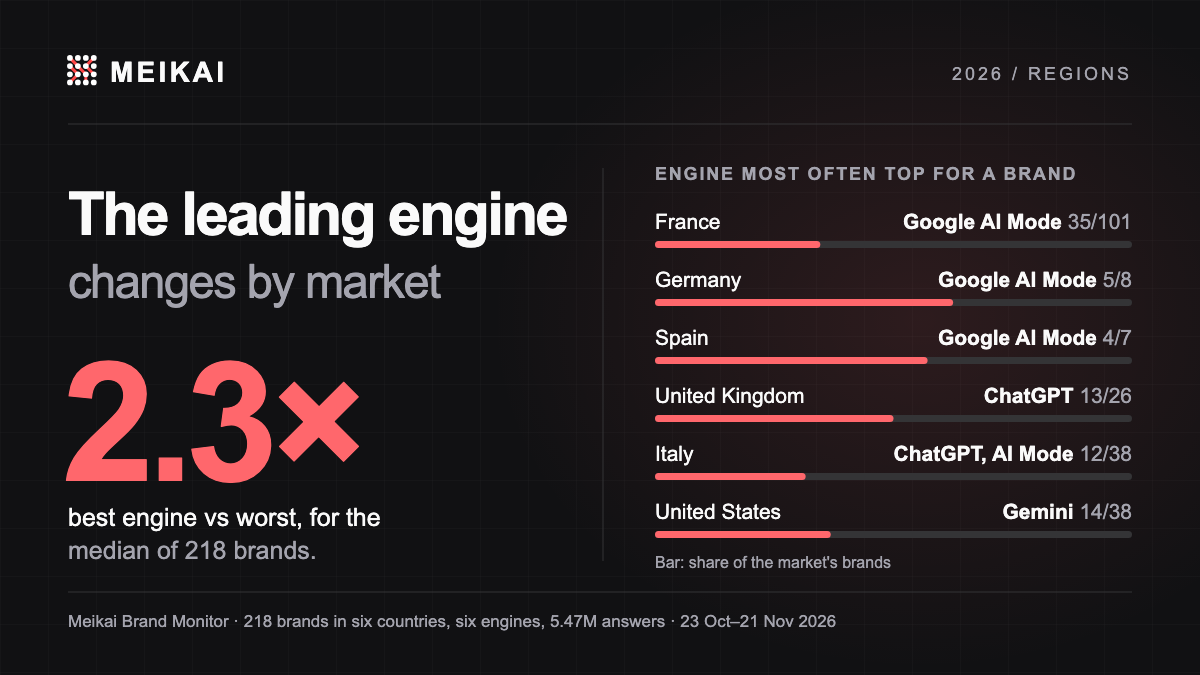
The AI engine that gives a brand its highest visibility differs from brand to brand, and the most common leader differs by market. Across 218 brands tracked by Meikai in six countries, Google AI Mode led most often in France, Germany and Spain, ChatGPT in the UK, and Gemini in the US. For the median brand, its best engine named it 2.3 times as often as its worst.
A global brand that tracks the same engines everywhere, or reports one score averaged across engines and markets, misses both effects.
Which AI engines do people use in each market?
In Statcounter’s AI chatbot market share for October 2026, ChatGPT is first worldwide with 51.6%, and Gemini is ahead of it in Italy, Spain and Japan:
| Market | ChatGPT | Gemini | Perplexity | Copilot | Claude |
|---|---|---|---|---|---|
| Worldwide | 51.6% | 28.9% | 15.0% | 2.2% | 2.3% |
| United States | 37.1% | 35.4% | 10.3% | 11.2% | 5.7% |
| United Kingdom | 44.4% | 31.1% | 9.7% | 10.6% | 4.2% |
| France | 43.3% | 36.4% | 12.1% | 3.6% | 4.7% |
| Germany | 41.5% | 34.9% | 15.9% | 3.7% | 4.0% |
| Italy | 29.7% | 51.9% | 11.3% | 3.7% | 3.4% |
| Spain | 41.7% | 44.0% | 9.3% | 2.9% | 2.1% |
| Japan | 34.9% | 45.6% | 7.0% | 10.1% | 2.3% |
Copilot holds about a tenth of the market in the US, the UK and Japan, and less than 4% in France, Germany, Italy and Spain. Perplexity is strongest in Germany, at 15.9%.
Two groups of engines are missing from this table. Google AI Overviews and Google AI Mode sit inside Google Search, so Statcounter does not list them as chatbots, yet they appear in Google results in the markets where Google has launched them. And in some markets the main engines are local: buyers in China use Wenxin, Qwen, Doubao and DeepSeek, and buyers in South Korea use Naver AI Tab. Our enterprise GEO buyer’s guide covers how to check a vendor’s engine list.
Does a brand get the same visibility on every engine?
Visibility on the same prompts varies widely by engine. Meikai ran each brand’s prompts on six engines every day between 23 October and 21 November 2026: ChatGPT, Gemini, Google AI Mode, Google AI Overviews, Perplexity and Copilot. Every engine received the same prompts for a given brand, so comparisons between engines are like for like. Visibility is the share of answers that name the brand.
| Market | Brands | Engine with the highest visibility most often | Engine with the lowest visibility most often | Median gap between a brand’s best and worst engine |
|---|---|---|---|---|
| France | 101 | Google AI Mode (35 brands) | Perplexity (62) | 14.0 points |
| Italy | 38 | ChatGPT and Google AI Mode (12 each) | Perplexity (26) | 14.3 points |
| United States | 38 | Gemini (14) | Perplexity (28) | 11.6 points |
| United Kingdom | 26 | ChatGPT (13) | Perplexity (13) | 7.4 points |
| Germany | 8 | Google AI Mode (5) | Perplexity (7) | 5.1 points |
| Spain | 7 | Google AI Mode (4) | Perplexity (7) | 7.1 points |
Across the 218 brands:
- Perplexity gave the lowest visibility for 143 of the 218 brands, and had the lowest median visibility in all six markets.
- Which engine gave the highest visibility depended on the market and on the brand. Only in Germany and Spain, the two smallest samples, did one engine lead for more than half the brands.
- The median brand’s best engine named it 12.2 points more often than its worst, or 2.3 times as often.
Because the brands differ between markets, the table cannot say whether an engine favours a country.
Do AI engines cite local sources?
The widest gap between engines in one market was in Germany, where the share of citations going to the country domain differed by 25.9 points. We counted the share of each engine’s citations that point to a site on the market’s own country domain, such as .de in Germany or .co.uk in the UK. In every European market, Gemini or Copilot had the highest share of citations to local domains, and in four of the five, ChatGPT and Google AI Overviews had the two lowest shares.
| Market | Most local engine | Least local engine | ChatGPT | Google AI Overviews |
|---|---|---|---|---|
| Germany (.de) | Gemini, 66.1% | ChatGPT, 40.2% | 40.2% | 50.6% |
| Italy (.it) | Gemini, 52.1% | ChatGPT, 31.5% | 31.5% | 36.0% |
| France (.fr) | Copilot, 47.7% | Google AI Overviews, 35.0% | 40.0% | 35.0% |
| Spain (.es) | Gemini, 38.3% | Google AI Overviews, 25.2% | 27.5% | 25.2% |
| United Kingdom (.uk) | Copilot, 33.8% | Perplexity, 22.8% | 31.2% | 24.1% |
After Germany, the widest gap was in Italy, at 20.6 points. In both countries, sites on the country domain made up a far larger share of Gemini’s citations than of ChatGPT’s: 66.1% against 40.2% in Germany, 52.1% against 31.5% in Italy.
Engines also differ in how often they cite anything. Perplexity cited at least one source in 99% of its answers in every market. Gemini did so in 44.0% of Italian answers and 65.4% of US answers. In Italy, where Gemini leads usage, more than half of its answers in our data listed no source, so they cannot be traced back to a page.
What does consistent regional coverage require?
- Pick the engines for each market from the ones people use there. Add Google AI Overviews and AI Mode where Google leads search, and local engines where they lead. Keep the list fixed from one report to the next.
- Write the prompts in each market’s language. A list translated from English can miss the questions local buyers ask.
- Use the same definitions of visibility, share of voice and citations in every market. Otherwise, differences between markets may come from the method rather than from the markets themselves.
- Report each engine and each market separately, with the number of answers behind each figure. A blended score hides the weak market or engine.
- If leadership wants one regional number, decide whether engines count equally or by usage, and keep that rule between reports.
- Analyse sources market by market. The share of citations going to the country domain ranged from 22.8% to 66.1% across these markets and engines.
Can one workspace cover every region?
In Meikai, each brand in each market is tracked separately with its own prompts, competitors and engines. Meikai monitors 14 engines, including Wenxin, Qwen, Doubao, DeepSeek and Naver AI Tab, and on the Growth plan each brand covers six of them, chosen brand by brand, so each market can have its own list. Visibility can also be weighted by each engine’s Statcounter share instead of counting every engine equally.
Workspaces group brands by a fixed list or by rules based on brand names and tags, for example one workspace per region. Portfolio compares brands on one screen, up to seven per chart, so a regional team or an agency account team can see every market with the same definitions. Access is granted brand by brand, so a market team sees its own markets only. Our agency guide to running many clients covers access and scheduled reports in more detail.
What to ask a vendor about regional coverage
- Can each market have its own engines, and which local engines do you support?
- Do you query the consumer product in each market, or an API?
- Who writes the prompts for each market, and in which language?
- Can you report visibility per engine and per market, with the number of answers behind each figure?
- How do you build a regional or global total, and can we choose the weighting?
- What does one more market or one more engine cost?
For a wider comparison of vendors, see the enterprise GEO buyer’s guide. For how many prompts each market needs before its figure holds still, see our prompt-set analysis. Or talk to Meikai about a set-up across your markets.
How we measured
Meikai Brand Monitor data from 23 October to 21 November 2026. We kept every brand tracked in France, Germany, Italy, Spain, the UK or the US on all six engines (ChatGPT, Copilot, Gemini, Google AI Mode, Google AI Overviews and Perplexity), with at least 200 answers per engine: 218 brands and 5.47 million answers. Brands are not named. Each brand had its own prompts for its market, and every engine received the same prompts on the same days.
Visibility is the share of a brand’s answers on an engine that name the brand. The highest and lowest engines were counted for each brand, with a tie counted for each engine involved. The gap is the difference between a brand’s highest and lowest engine, and the median is taken across brands.
Local citations are citations whose registered domain ends in the market’s country code (.fr, .de, .it, .es or .uk), out of all citations from that engine for those brands. The measure undercounts local sites that use .com, such as the local editions of international retailers, so it is a lower bound. The same rule applies to every engine, but an engine that cites more local .com sites will look less local than it is. The US is excluded because US sites rarely use .us. The share of answers with a citation counts answers that list at least one cited source.
The brand mix differs between markets, so differences between markets reflect the brands as well as the engines. The comparisons between engines within a market do not have this problem. Germany (8 brands) and Spain (7) are small samples.
Usage shares are Statcounter’s AI chatbot market share for October 2026, read from its worldwide and country pages on 24 November 2026. Statcounter does not list Google AI Overviews or Google AI Mode in this series.
Frequently asked questions
How can a global brand get consistent AI platform coverage across regions?
Choose the engines for each market from the engines people use there, write prompts in each market's language, keep the same metric definitions everywhere, and report visibility per engine and per market with the number of answers behind each figure. If you need a regional total, fix the weighting rule and keep it between reports.
Which AI engines should global brands monitor in 2026?
ChatGPT and Gemini in almost every market, Google AI Overviews and AI Mode where Google leads search, then Perplexity and Copilot depending on the market. In Statcounter's October 2026 data, Gemini led ChatGPT in Italy, Spain and Japan, and Copilot held about a tenth of the market in the US, the UK and Japan but less than 4% in France, Germany, Italy and Spain. Add local engines such as DeepSeek or Naver AI Tab where they lead.
What AI engines are customers using for brand recommendations now?
Mostly ChatGPT and Gemini, with Perplexity, Copilot and Claude behind them, plus Google AI Overviews and AI Mode inside Google Search. The mix changes by country: ChatGPT leads in the US, UK, France and Germany, and Gemini leads in Italy, Spain and Japan.
Can one system track AI visibility across global markets?
Yes, if it tracks each market separately with its own prompts and engines and uses the same definitions everywhere. In Meikai, each brand in each market has its own prompts, competitors and engines, and workspaces and Portfolio compare markets on one screen.
Can agencies manage regional AI coverage from one workspace?
Yes. In Meikai, an agency can group a client's markets into one workspace with a fixed list or with rules based on brand names and tags, compare them in Portfolio, and grant access brand by brand so that each market team sees only its own markets.