 MEIKAI
Choosing a GEO platform for agencies: how to run AI visibility across 20 clients
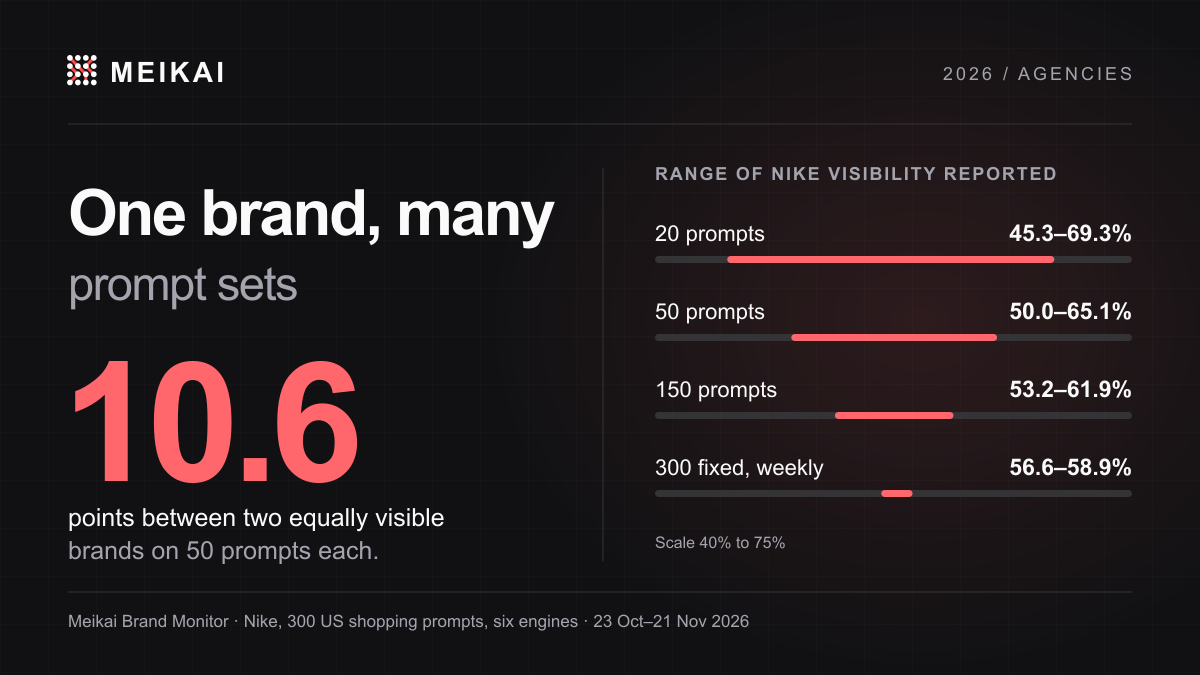
Track two equally visible brands on 50 prompts each, and one can still score more than ten points above the other. The difference comes from the questions each set happens to contain.
We measured this on the 300 US shopping prompts Meikai tracks for Nike, our demonstration brand. Then we drew prompt sets of different sizes from those questions, as an agency would when it sets up a new client. The results show how many prompts each client needs before an agency reports on 20 of them at once.
What makes a GEO platform work across many clients?
Five things matter more for agencies than the length of the feature list:
- A separate scope for each client, so a client user sees only that client's brands.
- A view across clients for the agency team, with the same metric definitions for each one.
- Enough prompts per client for the figure you report to hold still. The next section shows how many that is.
- Reports that go out on schedule, without someone rebuilding them each month.
- A price you can quote per client and pass on in a retainer.
How many prompts does each client need?
That depends on the question the client asks. Tracking one client over time takes fewer prompts than ranking it against other brands.
Nike was named in 57.6% of the answers to its 300 prompts between 23 October and 21 November 2026, across six engines. Individual prompts ranged from 0% to 100%: Nike appeared in fewer than one answer in ten for 8% of the prompts and in at least eight answers in ten for 26%. With prompts that varied this much, a small set can easily draw more easy questions, or more hard ones, than the full list.
We drew 20,000 random prompt sets of each size from Nike’s questions and recorded the visibility each set would have reported:
| Prompts per client | Range reported by 95% of sets | Gap between two equally visible brands, reached in 1 comparison in 20 |
|---|---|---|
| 20 | 45.3% to 69.3% | 16.9 points |
| 50 | 50.0% to 65.1% | 10.6 points |
| 150 | 53.2% to 61.9% | 6.1 points |
| 300 | 54.5% to 60.7% | 4.4 points |
The last column matters when a client asks whether it is ahead of a competitor. If two brands are equally visible but each is measured on its own 50 prompts, one in twenty comparisons will show a gap of 10.6 points or more.
Tracking the same client over time is different, because the prompts stay fixed. With Nike’s 300 prompts unchanged, weekly visibility read 58.9%, 56.6%, 57.4% and 57.2% over four weeks. The question set no longer moves the figure, so a change of a few points between months is worth looking into.
In practice:
- For month-by-month tracking of one client, a fixed set of around 50 well-chosen prompts is a workable start. Keep the set fixed between reports.
- Comparing clients, or a client against its competitors, needs a shared set of category prompts. Move to 150 or more when the brands are close.
- Each market needs its own prompts, written in the local language rather than translated from one list.
Repeating each prompt several times a day matters less than the number of prompts. In Meikai’s study of 250,000 answers, one run a day on 500 prompts put 95% of ten-day citation-share estimates within 0.17 points of the full result. Ten runs a day narrowed that to 0.05 points, at ten times the cost.
Can an agency compare clients against each other?
Yes, if each client in the comparison is measured on the same category prompts, engines, market and dates. Questions about a single client’s products or services still belong in that client’s own report. Our guide to the AI engines agencies should compare explains how to set up a fair benchmark and which engines to include.
In Meikai, Portfolio compares the brands an agency manages on one screen, with each brand’s visibility, share of voice and ranking. Each chart shows up to seven brands at a time, so for a larger roster, select the brands to compare or open the workspace for one account team.
What does a GEO platform cost per client?
With Meikai, each client brand in each market is one plan. The cost for 20 clients, each tracked in one market:
| Plan | Per client per month | 20 clients per month | 20 clients per year, billed yearly |
|---|---|---|---|
| Starter | EUR 90 | EUR 1,800 | EUR 18,000 |
| Growth | EUR 390 | EUR 7,800 | EUR 78,000 |
| Enterprise | EUR 1,300 | EUR 26,000 | EUR 260,000 |
Billed yearly, twelve months cost the price of ten. An agency can mix plans: 15 clients on Starter and 5 on Growth would cost EUR 3,300 a month. Starter covers ChatGPT only, with 50 prompts. Growth covers six engines of your choice with 150 prompts. A client in three markets counts as three plans, so markets usually drive the budget more than the plan does. Current prices are on the pricing page.
Ask other vendors the same question: what one more client, one more market or one more engine would cost. Pricing can be set by brand, prompt, seat or engine, and the model changes what a retainer costs.
How should client access work?
Agency staff need access to many clients. Client users need access to their own brand only. In Meikai, the agency assigns brand access user by user, as a viewer, editor or owner. A user can never grant someone more access than they have themselves, and up to 100 people can be invited in one batch.
Workspaces group brands, for example by account team or by sector, using a fixed list or rules based on brand names and tags. A user who lacks access to any brand in a workspace cannot open it. This stops a workspace from showing a client’s data to someone outside that account.
How can an agency send monthly reports to 20 clients?
Build the report once and schedule it. In Meikai, a saved report is a table built from the analytics catalogue, such as visibility and share of voice by engine and week. It can be downloaded as XLSX or CSV, emailed immediately or sent on a schedule. Each scheduled send uses the last saved version of the report, and recipients get a download link that stays valid for seven days.
Agencies that already report in Looker Studio can use the Meikai connector. It reads one brand per data source with a read-only key, so each client’s dashboard draws on that client’s data only.
The report itself should follow the same structure for every client: visibility and share of voice by engine, the number of answers behind each figure, the change on the same prompts since last month, and the sources behind the biggest moves.
What should an agency ask a GEO vendor?
- Can each client have its own prompts, competitors and engines?
- Can a client user be limited to a single brand, and who can grant that access?
- Can the agency compare all its clients on one screen, using the same definitions?
- Can reports be scheduled, and in which formats?
- What does one more client, market or engine cost?
- How many prompts does each plan include, and can the vendor show how much the figure moves at that size?
Our enterprise GEO buyer’s guide compares the main vendors and the answers worth hearing in a demo. For a wider list of tools, see our comparison of GEO tools, or talk to Meikai about an agency set-up.
How we measured
Meikai Brand Monitor tracked Nike on 300 US shopping prompts from 23 October to 21 November 2026, on ChatGPT, Copilot, Gemini, Google AI Mode, Google AI Overviews and Perplexity. Each prompt had about 180 answers. A prompt’s visibility is the share of its answers that named Nike.
For each set size, we drew 20,000 random sets from the 300 prompts and averaged their visibility. A prompt could be drawn more than once, which treats Nike’s prompts as a sample of the questions a client could track. The range in the table covers the middle 95% of those averages. For the gap between two brands, we drew two independent sets 5,000 times. One pair in 20 differed by at least the gap shown.
The simulation measures only the effect of choosing prompts. Run-to-run variation is already averaged within each prompt’s 180 answers. The weekly figures cover ISO weeks from 26 October to 22 November with all 300 prompts. The results describe one brand in one category, and categories where prompts vary less will need fewer prompts.
Frequently asked questions
Which GEO platform is easiest for an agency to use across clients?
Look for a separate scope and access control for each client, a view comparing all clients with the same definitions, scheduled reports, enough prompts per client for a stable figure, and a price per client you can quote. Ask each vendor to show these on your own client list.
How many prompts does each agency client need?
For tracking one client over time on a fixed set, around 50 well-chosen prompts is a workable start. For comparing brands, use a shared set and move to 150 or more. In Meikai's Nike data, two equally visible brands measured on different 50-prompt sets could differ by 10.6 points.
What would a multi-client GEO platform cost an agency?
With Meikai, each client brand in each market is one plan, from EUR 90 a month on Starter and EUR 390 on Growth. Twenty clients on Growth in one market each cost EUR 7,800 a month. Billed yearly, twelve months cost the price of ten.
Can clients see only their own data?
Yes. In Meikai, agencies assign brand access user by user, as a viewer, editor or owner. A user cannot grant more access than they hold, and a workspace opens only for users who can access every brand in it.
How can an agency send monthly AI visibility reports to many clients?
Save one report per client and schedule it. Meikai sends XLSX or CSV reports by email with a download link valid for seven days, and the Looker Studio connector reads one brand per data source with a read-only key.