 MEIKAI
Which AI search platforms should an agency compare for its clients?
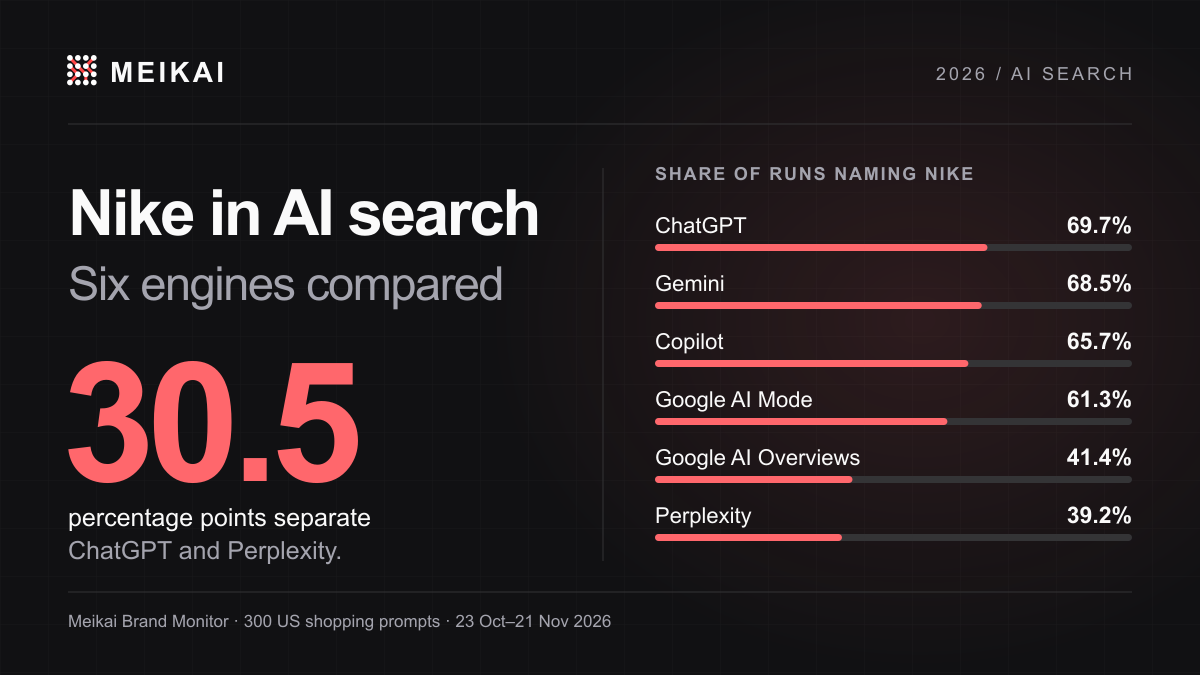
We asked ChatGPT and Perplexity the same 300 US shopping questions every day for a month. Most were about sports shoes. ChatGPT named Nike in 6,274 of 9,000 runs (69.7%). Perplexity named it in 3,526 (39.2%).
For a client report, put visibility and share of voice side by side for each engine. Across the six we tested, Gemini ranked second for how often it named Nike (68.5% of runs) and last for Nike's share of voice (18.8% of brand mentions).
Which AI search platforms should an agency compare?
For a US retail client, start with ChatGPT, Gemini, Copilot, Perplexity and Google's two search features, AI Mode and AI Overviews. Give the two Google products separate rows. On our shopping questions, Nike appeared in 61.3% of AI Mode runs and 41.4% of searches we checked for an AI Overview.
Choose the engines for each client's market. The shortlist for South Korea might include Naver AI Tab. In China, consider Wenxin, Qwen, Doubao and DeepSeek. If a client already sees referrals from Claude or Grok, include that engine in the comparison.
Meikai monitors 14 engines. Growth and Enterprise customers can choose six for each brand. A custom plan covers all 14.
How often did each engine name Nike?
Visibility is the percentage of recorded runs in which a brand appeared. We counted each US shopping question once per engine per day, from 23 October to 21 November 2026. The competitor column counts runs that named at least one other brand, whether or not Nike also appeared.
| Engine | Nike visibility | Adidas visibility | Nike share of voice | Runs naming a competitor |
|---|---|---|---|---|
| ChatGPT | 69.7% | 56.0% | 24.0% | 89.6% |
| Gemini | 68.5% | 59.3% | 18.8% | 90.4% |
| Copilot | 65.7% | 55.3% | 20.8% | 89.6% |
| Google AI Mode | 61.3% | 44.4% | 20.5% | 90.0% |
| Google AI Overviews | 41.4% | 34.8% | 22.1% | 61.6% |
| Perplexity | 39.2% | 31.5% | 21.4% | 64.2% |
Google showed an AI Overview in 6,205 of 9,000 searches. The other 2,795 showed none. Nike appeared in 3,729 of those Overviews. That works out to 41.4% of all searches, the figure in the table, or 60.1% of the Overviews shown.
At least one Nike competitor appeared in 61.6% of all searches checked for an Overview, or 89.3% of the Overviews shown. On Perplexity, 64.2% of runs named a competitor. Nike accounted for 21.4% of the brand mentions there.
Do AI engines rank competitors differently?
Nike, Adidas, New Balance, ASICS and Brooks ranked first to fifth, in that order, on all six engines. The choice of engine mattered more for some of the smaller brands.
| Brand | Highest visibility | Lowest visibility | Ratio |
|---|---|---|---|
| Nike | 69.7% (ChatGPT) | 39.2% (Perplexity) | 1.8× |
| Adidas | 59.3% (Gemini) | 31.5% (Perplexity) | 1.9× |
| ASICS | 41.0% (Gemini) | 19.6% (Perplexity) | 2.1× |
| Hoka | 24.7% (Gemini) | 9.2% (Perplexity) | 2.7× |
| Puma | 17.2% (Gemini) | 5.3% (Perplexity) | 3.3× |
| On Running | 14.3% (Gemini) | 2.9% (Perplexity) | 4.9× |
Take On Running. It appeared in 14.3% of Gemini runs, 6.1% on ChatGPT and 2.9% on Perplexity. A ChatGPT-only report would miss both its strongest and its weakest showing.
Which sources does each AI engine cite?
ChatGPT linked to a source in nearly every run. Google AI Overviews included a source in 5,807 of the 6,205 Overviews shown (93.6%). The table uses all 9,000 Google searches so that a search with no Overview counts as a run with no citation.
| Engine | Runs citing a source | Citations per run | Distinct domains cited |
|---|---|---|---|
| ChatGPT | 99.7% | 14.1 | 4,163 |
| Perplexity | 99.1% | 6.4 | 3,230 |
| Copilot | 81.1% | 4.3 | 2,462 |
| Google AI Overviews | 64.5% | 4.2 | 1,861 |
| Gemini | 71.3% | 3.5 | 1,587 |
| Google AI Mode | 59.8% | 1.7 | 1,131 |
- Google AI Overviews linked to YouTube in 3,811 of the 9,000 searches (42.3%). Among the Overviews shown, that was 61.4%.
- ChatGPT linked to RunRepeat, a shoe review site, in 41.8% of runs. The next-highest rate was 20.2% on Google AI Overviews.
- Copilot cited Amazon in 17.6% of runs. ChatGPT did so just nine times in 9,000 runs.
- Perplexity linked to nike.com in 21.3% of runs. Gemini and Google AI Mode each did so in 3.7%.
If a shoe client asks where to concentrate its outreach, look at the sources its own buyers' questions turn up. For these prompts, that would mean reading RunRepeat's reviews for ChatGPT and watching the videos Google linked to. Our study of 2.36 million AI answers compares citation patterns across categories.
How do agencies benchmark several clients against the same competitors?
Build the benchmark from category questions all clients share. Run them in the same market, on the same engines and dates. Use the same list of rivals for competitor comparisons.
For two shoe brands, “Which running shoes work well on wet pavement?” could go in the shared set. A question about one brand's returns policy belongs in its own report. Including it in the benchmark would give that brand an extra chance to appear by name.
In Meikai, an agency can set prompts and competitors for each brand and view its brands together in Portfolio. Keep client-specific questions and competitors in a separate breakdown when preparing the report.
Check for names missing from the agreed list, too. Salomon appeared in 3.5% of runs even though it was outside Nike's tracked set, close to Allbirds (3.7%) and Altra (3.6%). Meikai's visibility ranking can surface competitors like Salomon. If you add one, record when the comparison set changed.
What should a monthly AI search report show?
Start with the change in visibility and share of voice for each engine. Give the number of runs behind each figure. For Google AI Overviews, also give the number of searches that produced an Overview.
Then show the client which questions it gained or lost, which competitors appeared, and which pages the answers cited. If the client updated a product page or placed an article, show the results for the same questions before and after the change.
Keep newly added questions in their own group for the first report. Otherwise, changing the mix can look like a gain or loss in visibility. Our study of 250,000 answers shows how repeated runs affect the precision of a visibility estimate.
What should agencies check in an AI visibility platform?
Ask the vendor to build a report for one of your clients. Work through these questions during the demo.
- Can you choose different engines for each client and report visibility, share of voice and citations for each engine?
- Can you open the dated answers behind a figure and inspect their sources?
- Can the client see just its own brands? In Meikai, workspaces group brands and you can set access for each brand.
- Can the client receive the report in the format it already uses? Meikai's Report Builder exports Excel and CSV files and can email reports on a schedule. Dashboards export to PDF. Agencies can also use the Looker Studio connector, the MCP server or the REST API.
- Can you check a suggested change? Meikai's Site Scanner, for example, flags blocked crawlers. After a client changes access, scan the site again to check the result.
How quickly can an agency start tracking a new client?
If the client has a list of customer questions, import it into Prompt Studio from CSV or Excel. Otherwise, Prompt Studio can draft questions using the brand, market and search demand. Review the list with the client before starting daily collection. Allow a few weeks for the first trend report.
Which AI visibility signals matter in a client pitch?
Pick a question the prospect's customers ask. Show an answer that recommends a competitor, open the source it cites, and explain what the agency would investigate first.
For the Volkswagen ID. Polo campaign, Re-Mind PHD used Meikai to compare 139 publishers by how much more often answers mentioned the car when they cited a publisher. The agency selected two of the top five and then measured how often answers citing the campaign articles named the car.
For help choosing the software behind the report, see our comparison of GEO tools or talk to Meikai.
How we counted
Meikai Brand Monitor tracked Nike, our US demonstration brand, from 23 October through 21 November 2026. We recorded 53,985 runs across 300 US shopping prompts. Five engines had 9,000 runs each and Copilot had 8,985. For Google AI Overviews, we checked whether Google returned Overview text. The 2,795 searches without it contributed zero brand mentions and zero citations.
For visibility, a brand counts once per run if the text contains its name or a recognized alias. For share of voice, each mention counts, including repeated mentions in an answer. We divided Nike's mentions by all counted brand mentions on that engine, excluding competitors marked as ignored.
A run can cite several pages. We divided the total number of citations by all recorded runs to get citations per run. A domain's citation rate counts each run only once, however many links point to that domain. The results describe US shopping questions about one category during this month.
Frequently asked questions
Which AI search platforms should an agency compare first?
For US retail clients, start with ChatGPT, Gemini, Copilot, Perplexity, Google AI Mode and Google AI Overviews. Report AI Mode and AI Overviews separately. Adjust the list for each client's market and sources of referral traffic.
How often did Google AI Overviews name Nike?
Google showed an Overview in 6,205 of 9,000 US shopping searches. Nike appeared in 3,729. That was 41.4% of all searches and 60.1% of the Overviews shown.
How should an agency compare two clients fairly?
Use the same category questions, market, engines and dates for both clients. Compare them against the same competitors. Put questions about a single client's products or policies in its own report.
Which sources do different AI engines cite?
On these US shopping prompts, Google AI Overviews cited YouTube in 42.3% of searches, ChatGPT cited RunRepeat in 41.8% of runs, Copilot cited Amazon in 17.6% and Perplexity cited nike.com in 21.3%.
Can AI search benchmarking reveal new competitors?
Yes. Salomon appeared in 3.5% of runs even though it was outside Nike's tracked set. That put it close to two tracked competitors, Allbirds at 3.7% and Altra at 3.6%.
What should a monthly AI search report show a client?
Show visibility and share of voice for each engine, the number of runs, and the change on the same prompts since last month. Include examples of questions where the client gained or lost ground and links to the sources in those answers.