 MEIKAI
Does ranking on Google get you cited by ChatGPT? Two 2026 studies tested on 2.36 million AI answers
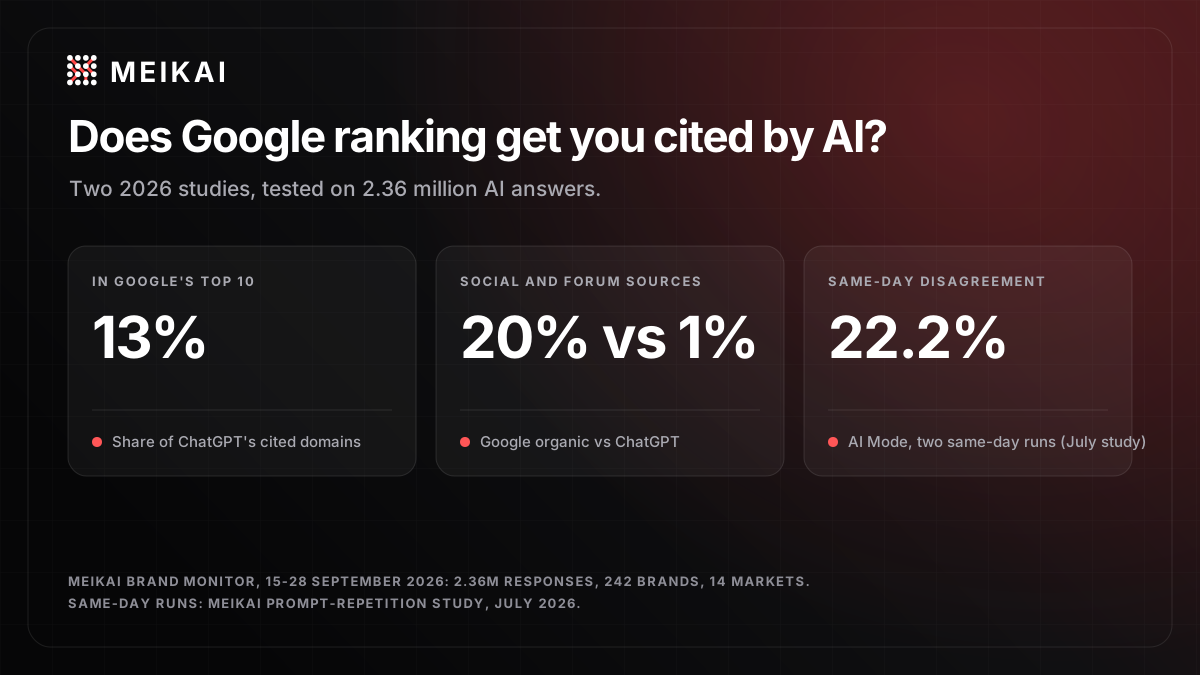
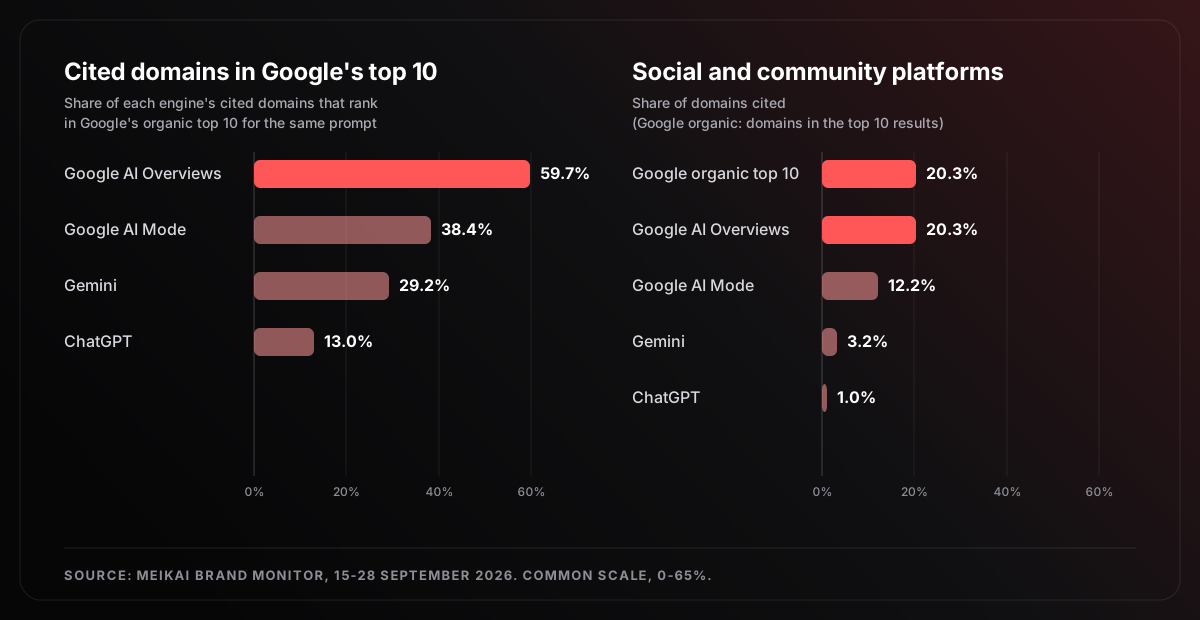
Ranking in Google's top 10 says little about whether ChatGPT will cite a page. In 2.36 million AI answers collected by Meikai in September 2026, only 13% of the domains ChatGPT cited ranked in Google's organic top 10 for the same prompt, and 73.5% of ChatGPT answers with sources cited no top-10 domain at all. Google's own AI features sat closer to its rankings: 60% of the domains cited by AI Overviews, the AI summary above Google's results, ranked in the top 10, against 38% for AI Mode, Google's conversational search, and 29% for Gemini.
These figures test two 2026 papers that compared Google with AI engines through developer APIs: one from the University of Toronto (Chen et al., 2026) and one from Ruhr University Bochum and the Max Planck Institute for Software Systems, covering 4,706 queries (Kirsten et al., Findings of ACL 2026). Meikai Brand Monitor instead collects answers from the consumer apps people actually use, every day, for 242 brands in 14 markets.
In short: a Google top-10 ranking predicts citations in AI Overviews, partly in AI Mode and Gemini, and little in ChatGPT. ChatGPT cites newer pages than Google, almost never cites social platforms and changes its sources fastest. In Meikai's data, the Gemini app showed no citation in half of its answers, whereas Kirsten et al. found the Gemini API searched for almost every query.
Does ranking on Google help you get cited by AI?
Mainly in Google AI Overviews. For each tracked prompt with an AI Overview, we compared the domains each engine cited with Google's organic top 10 from the same request, market and day.
| AI engine | Cited domains that rank in Google's top 10 | Answers citing no domain from the top 10 |
|---|---|---|
| Google AI Overviews | 59.7% | 3.8% |
| Google AI Mode | 38.4% | 36.4% |
| Gemini | 29.2% | 44.7% |
| ChatGPT | 13.0% | 73.5% |
Kirsten et al. measured a lower share for AI Overviews: 47% of cited domains were in the organic top 10 and 53% outside it, against 60% and 40% in Meikai's data. Chen et al. also found almost no link between ChatGPT's sources and Google's top 10; on their stricter similarity measure, GPT-4o scored 4.0% and Gemini 11.1%, against 3.1% and 8.9% in Meikai's data. AI Mode sits between AI Overviews and the assistants.
Gemini needs a caveat. In the consumer app, half of the answers Meikai collected showed no citation, whereas Kirsten et al. found the Gemini API searched for more than 99.5% of queries. Benchmarks run through APIs can overstate how often the Gemini app your customers use cites anything.
Which types of sources do AI engines cite?
ChatGPT and Gemini rarely cite social and community platforms, in line with Chen et al. Such platforms made up 20.3% of the domains in Google's organic top 10, but only 3.2% of those Gemini cited and 1.0% of those ChatGPT cited. Google's AI features differ: AI Overviews cited them as often as organic search (20.3%), AI Mode came in at 12.2%, and YouTube alone accounted for 37% and 43% of those citations respectively.
Chen et al. also found that AI engines favour earned media such as independent publishers. Here the effect was small: 18.2% of ChatGPT's cited domains and 15.2% of AI Mode's, against 13.7% for Google organic, with Gemini and AI Overviews level with it.
On purchase intent, Chen et al. found that shopping queries push AI engines towards brand-owned pages. In Meikai's data, moving from awareness to conversion prompts raised the share of citations going to commercial sites (brand sites, retailers, marketplaces, comparison and affiliate sites) on every engine:
| Engine | Commercial sites, awareness prompts | Conversion prompts | Change |
|---|---|---|---|
| ChatGPT | 54.1% | 71.5% | +17.4 points |
| Google AI Mode | 60.4% | 70.7% | +10.3 points |
| Google AI Overviews | 56.8% | 64.3% | +7.5 points |
| Gemini | 73.9% | 81.0% | +7.1 points |
| Google organic top 10 | 54.2% | 60.7% | +6.5 points |
Here our data did not match the paper. Retailers, marketplaces and comparison sites took most of the increase, not the brands' own websites: sites owned by the tracked brand or its competitors gained 4.8 points on ChatGPT, 2 to 3 points on Gemini and Google's AI features, and 0.8 points in Google organic results.
Do AI engines cite fresher pages than Google?
ChatGPT does. The median dated page it cited was 168 days old, against 365 days for the median dated Google result for the same prompts, and pages from the previous 90 days made up 34.6% of its dated citations against 12.1% of Google's. Chen et al. reported the same direction.
ChatGPT was the only engine whose cited pages carried enough publication dates to test, and Google's dates can only be read in English, so the comparison covers English-language markets, mostly the UK (84% of prompts). Dates were available for 39% of ChatGPT's cited pages and 14% of Google's results; since Google rounds ages down, the real gap is probably wider.
How stable are AI citations and answers?
Less stable than Google's organic results. Kirsten et al. ran their queries two months apart and found that only 18% of the pages cited by AI Overviews appeared in both runs, against 45% for organic search. Meikai ran a comparable page-level test, scoring how many cited URLs a prompt shared on 28 September with the same prompt 1 and 56 days earlier.
| Engine | 1 day apart | 56 days apart |
|---|---|---|
| Google organic top 10 | 52.8% | 25.3% |
| Google AI Overviews | 28.0% | 10.8% |
| Gemini | 25.3% | 13.8% |
| Google AI Mode | 19.0% | 6.5% |
| ChatGPT | 15.1% | 3.9% |
Our figures are lower than Kirsten et al.'s, but the gap is similar: organic results kept about 2.3 times as many of the same pages as AI Overviews over two months, against 2.5 times in the paper. ChatGPT changed fastest, sharing only 3.9% of pages after 56 days.
The answers move too. Kirsten et al. found that even at temperature zero, 9% to 27% of deliberately ambiguous yes-or-no questions flipped within five minutes. In Meikai's prompt-repetition study, two same-day runs of a prompt disagreed on whether the study brand was mentioned in about one case in five on ChatGPT, Gemini and AI Mode, although the variation largely cancelled out across a broad set of prompts.
How often do AI engines name a brand without a source?
In Meikai's data, about 16% of answers that named a tracked brand cited no page mentioning it (adjusted estimate, range 11.5% to 21.8%; 18.7% among answers whose cited pages could all be checked). The rate was about 9% on AI Overviews, which cite the most sources, about 17% on ChatGPT and Gemini, and 20% on AI Mode.
Chen et al. found almost the same rate: 16% of the entities GPT-4o named in product rankings appeared in no retrieved snippet, and mainstream names such as Toyota were far better supported than Cadillac or Infiniti. Meikai's data shows the same split by visibility: across 175 brands, the most visible third were named without a supporting cited page in 13.1% of answers, against 23.5% for the least visible third.
What this means for brands
- SEO still matters for Google's AI answers, less for ChatGPT. A top-10 ranking helps most in AI Overviews. For ChatGPT, recently updated pages and listings on retailers, marketplaces and comparison sites count for more.
- Track each engine separately. Fewer than 40% of the domains cited by AI Mode, Gemini or ChatGPT ranked in Google's top 10, and only 13% for ChatGPT. Our AI brand visibility guide explains how to measure it.
- Match sources to the engine. YouTube and community platforms count in AI Overviews and AI Mode but barely register in ChatGPT and Gemini; see which sources shape brand perception.
- Read trends, then act. Answers vary from run to run, so decisions need a broad prompt set tracked over time, as explained in why prompt modeling is the foundation of AI visibility.
Meikai Brand Monitor tracks which domains ChatGPT, Gemini, AI Overviews and AI Mode cite for your brand and competitors every day, something Search Console cannot show. Talk to our team to see your own figures.
Methodology note
The analysis covers 2.36 million responses collected by Meikai Brand Monitor between 15 and 28 September 2026 from the consumer versions of ChatGPT, Gemini, Google AI Mode and Google AI Overviews: 242 brands, 87,213 prompts phrased as natural questions, and 14 markets, with about 42% of responses from France. Top-10 comparisons cover answers with at least one citation and prompts with at least five organic domains, compared at root-domain level; the comparison with Chen et al. uses their similarity measure, which divides the domains both lists share by all distinct domains in either list. Commercial sites combine the brand's own, competitor and other brands' sites with retailers, marketplaces, comparison, directory and affiliate sites. A small AI Overviews collection route that did not capture citations is excluded, and ChatGPT's earned-media share varies with the collection method.
The stability test compares cited URLs, without query strings, on 28 September and on 27 September or 3 August; the organic-to-AI Overviews ratio was 2.3 to 2.5 with other end dates. The adjusted estimate for unsupported mentions reweights the rate on fully checked answers to the citation-count mix of all answers naming the brand; the range assumes every unchecked page did, or did not, mention it. Same-day figures come from the July 2026 study (500 US English prompts, ten runs a day for ten days). Results describe the products during the observation period and will change as they do.
Sources
- Chen, Wang, Chen and Koudas, Navigating the Shift: A Comparative Analysis of Web Search and Generative AI Response Generation, EDBT/ICDT 2026 Workshops
- Kirsten, Grosse Perdekamp, Wu, Upadhyay, Gummadi and Zafar, Characterizing Web Search in the Age of Generative AI, Findings of ACL 2026
- Meikai: How many times should you run an AI visibility prompt?
Frequently asked questions
Does SEO help you get cited by ChatGPT?
Not much on its own. In Meikai's September 2026 data, only 13% of the domains ChatGPT cited ranked in Google's organic top 10 for the same prompt, and 73.5% of ChatGPT answers with sources cited no top-10 domain at all. Google rankings matter more for Google AI Overviews, where 60% of cited domains ranked in the top 10. ChatGPT's citations leaned towards recently published pages and, on purchase prompts, towards retailers, marketplaces and comparison sites.
Which types of sources do AI engines cite most?
Commercial sites (brand sites, retailers, marketplaces, comparison and affiliate sites) make up the majority of cited domains on ChatGPT, Gemini, AI Overviews and AI Mode, and their share rises on purchase-intent prompts. Social and community platforms make up about 20% of the domains cited by Google AI Overviews, as in Google's organic results, but only 3.2% for Gemini and 1.0% for ChatGPT.
How stable are AI answers and citations?
Less stable than Google's organic results. Over about two months, organic results kept about 2.3 times as many of the same pages as Google AI Overviews, and ChatGPT's citations changed fastest of all. Within a single day, two runs of the same prompt disagreed on whether the study brand was mentioned in about one case in five on ChatGPT, Gemini and AI Mode.
Can an AI engine mention a brand without citing a source about it?
Yes. In Meikai's September 2026 data, about 16% of answers that named a tracked brand cited no page mentioning it (an adjusted estimate; 18.7% among answers where every cited page could be checked). The rate was higher for less visible brands (23.5%) than for the most visible ones (13.1%). The mention may come from what the model already knows, or from pages it read but did not cite.