 MEIKAI
What ChatGPT's Business Hub Counts as a Mention (and What It Misses)
On 10 November 2026, OpenAI opened Business Hub in beta. Companies can claim their profile in ChatGPT, get verified and see how often ChatGPT "mentions" them. That last word needs a closer look.
For an online business, Business Hub counts a mention only when ChatGPT references the company's website. An answer that recommends the brand by name without referencing its site does not count. We measured the difference for 10 brands that we track in ChatGPT.
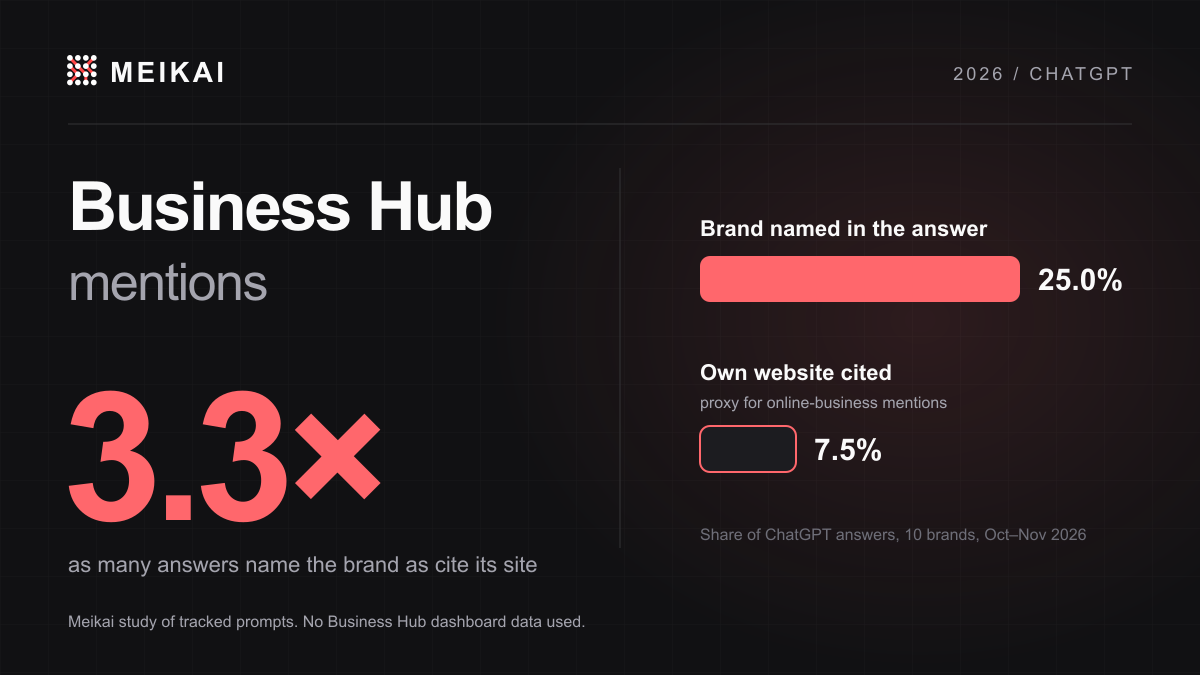
Across 68,643 ChatGPT answers, the brand was named in 25.0% and its own website was cited in 7.5%. That is 3.3 times as many name mentions as website citations. A website-based count leaves out many answers in which a customer would still see the brand.
What did OpenAI launch with Business Hub?
Business Hub lets verified companies update their details, add product feeds and view Insights. Eligible e-commerce and online service businesses in the US can also publish a Business Agent to answer customer questions in a separate, labelled conversation, and use it as an ad destination. Business Hub is open to eligible businesses where ChatGPT and the required verification are available. Local stores and restaurants can currently claim only an existing US listing.
Insights show mentions and website clicks over the past 28 days, plus "discovery topics": common themes of the conversations in which the company's website is cited. Businesses do not receive individual prompts or conversations. Metrics appear only once activity passes a reporting threshold.
How does ChatGPT Business Hub define a mention?
OpenAI's help centre gives two definitions, depending on the type of business. These are the rules as of mid-November 2026; they may change during the beta:
| Business type | What Business Hub counts as a mention |
|---|---|
| Online business | ChatGPT references your website. Your brand name alone does not count. |
| Local business | ChatGPT shows a result for your location, even if the user does not open the listing or visit the website. |
For an online business, this is close to what GEO tools call a citation of your own site. We initially read the dashboard tooltip as a count of any appearance of the brand in an answer. The help centre makes the narrower definition clear.
A citation links to one of your pages as a source. A brand mention puts your name in the answer. A consumer who asks for the best champagne for a wedding and reads your house's name has seen your brand, whether or not ChatGPT links to your website.
How much of a brand's visibility does a website-only count capture?
To see the gap in practice, we took 10 brands that Meikai tracks in ChatGPT and measured two things in the same 68,643 answers, collected between 17 October and 13 November 2026. First, how often the answer names the brand or one of its declared aliases, which is what Meikai calls a mention. Second, how often the answer cites a page from the brand's own website, which we use as a proxy for Business Hub's online-business mention definition. The brands span asset management, cognac and spirits, champagne, optical retail, dairy, luxury fashion, consumer electronics and cars, in the UK, the US, France, Italy and the Netherlands. We have anonymised them.
We did not use Business Hub dashboard data. Its figures come from real ChatGPT conversations; ours come from each brand's tracked prompts. Our citation measure also includes some parent-company domains that Business Hub may treat differently. The comparison illustrates the difference between the two definitions on this sample. It cannot predict a brand's dashboard figures.
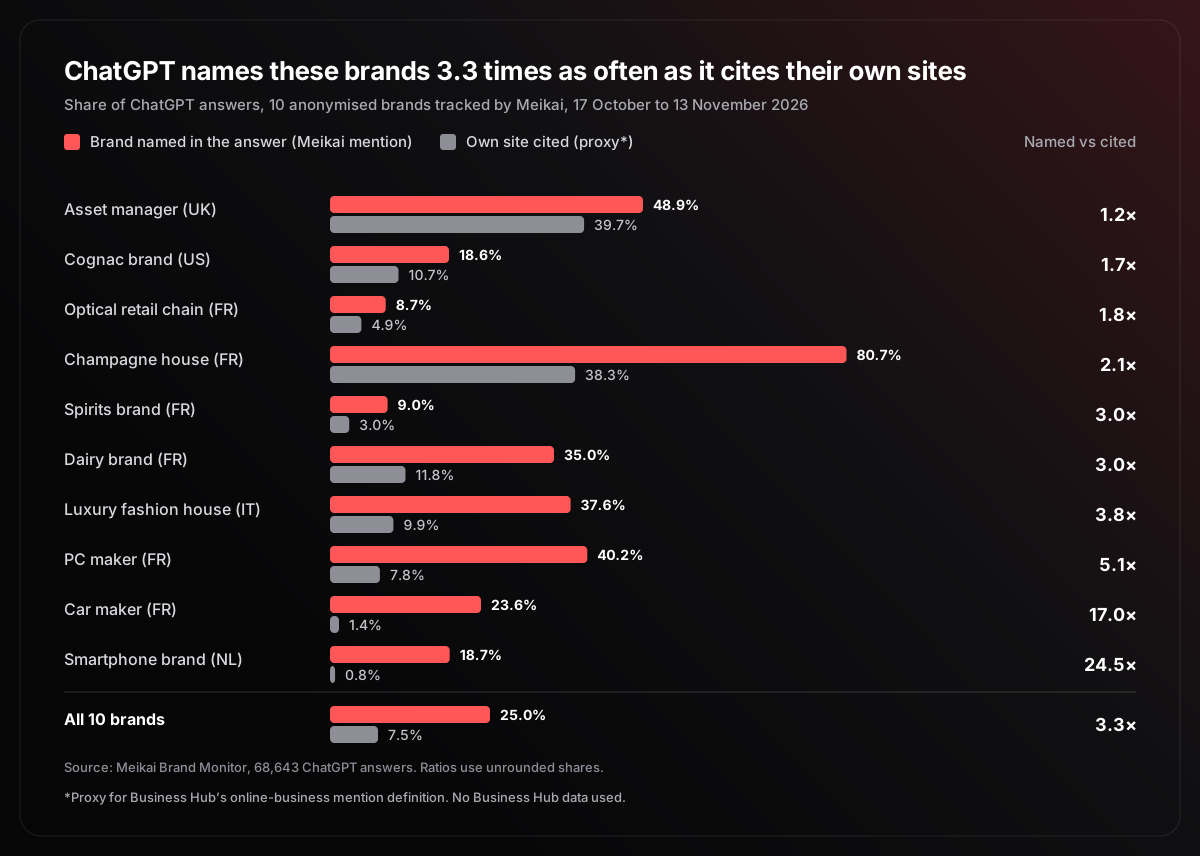
Every brand shows a gap, and its size varies widely: from 1.2 to 24.5, with a median of 3.0. It is widest for brands whose websites are rarely cited. For the car maker and the smartphone brand, a website-only count records one answer for every 17 and 24 that name the brand, and more than 96% of the answers that name them cite no page from their site. Even for the asset manager, the brand with the most cited site, more than four in ten of the answers that name it carry no reference to its site.
The reverse also happens. About a quarter of the answers that cite a brand's site never name the brand in the answer text. Those answers appear in our citation count but not our name-based count. Neither count contains the other.
| Measure, all 10 brands | Share of answers |
|---|---|
| Brand named (Meikai mention) | 25.0% |
| Own site cited (proxy for online-business mentions) | 7.5% |
| Named and cited | 5.6% |
| Named, site not cited: outside a website-based count | 19.4% |
| Cited, brand not named: outside a name-based count | 1.9% |
Of the answers that name a brand, 78% cite no page from its site. Tracking both measures shows when the name appears and when the website is cited. We saw the same distinction in retail, where being cited is not the same as being recommended.
What does the Business Hub view leave out?
Business Hub reports on your own business in ChatGPT. Several questions still need other data:
- Answers that name the brand through someone else. When ChatGPT recommends your product and links to a retailer, a marketplace, a review site or a magazine, your brand reaches the user but your website is not referenced. For brands sold through retailers, as in much of fashion, beauty, spirits and electronics, this can be most of their visibility.
- Competitors. Business Hub does not show how often competitors appear alongside your brand. You need that comparison to measure share of voice.
- The answers behind the numbers. Discovery topics group conversations into themes. They do not show the questions, the wording of the answers, your brand's position, the sentiment or the sources cited.
- Small numbers. Insights appear only above a reporting threshold, and OpenAI notes that a blank metric does not necessarily mean zero activity. Smaller brands and niche markets may see very little.
- Other assistants. ChatGPT is one engine. Your customers also ask Gemini, Google AI Mode and AI Overviews, Perplexity, Copilot, Claude, Grok, and in some markets Naver or Doubao. Each answers differently, and each cites different sources.
- Markets, segments and groups. Insights are a single 28-day aggregate. The help centre describes no breakdown by market, audience or prompt set. Each brand is managed separately, and central management across a group's brands is not available yet.
Will brands still need independent GEO tools?
For teams comparing brands across AI assistants, yes. The relationship is similar to Google Search Console and independent SEO tools: one reports activity on your own site; the others help you compare it with competitors. Business Hub adds data from real conversations, while independent tools let you examine answers to a chosen set of questions.
The usefulness of that comparison depends on how it is measured:
- Which questions are tracked? We build prompt sets from consumer panel data and search demand. The questions, markets and languages covered determine what a visibility figure can tell you.
- How are answers collected and counted? Results vary by interface, location and day. Brand names and aliases need consistent matching. Repeated runs help distinguish changes from ordinary variation, as our prompt-repetition study shows.
- What can you do with the result? Reading the answers and their sources helps you decide whether to improve your own pages, work with a retailer or publisher, or address a specific misconception about your product.
Ask any vendor, including Meikai, to explain its prompt selection, counting rules and coverage before comparing its numbers with Business Hub.
What this means for brands
- Claim and verify your Business Hub profile. Its Insights provide data on website references and clicks from real conversations. A product feed lets you share current prices and availability. Claiming a profile does not guarantee more visibility.
- Check the definition before comparing numbers. For an online business, a Business Hub mention requires a website reference. A GEO tool may count brand names in a different set of answers. The two figures are not directly comparable.
- Keep an independent view of the market. Share of voice against competitors, visibility across engines and markets, and the prompts and sources behind each answer still need a dedicated tool.
- Investigate the gap. If your brand is named but your site is rarely cited, check which sources appear instead. Retailer links may already serve your sales goals. If you want more visits to your own site, examine the cited pages and the questions they answer.
Meikai tracks brand mentions and website citations across 14 AI engines. To see the answers and sources behind your brand's visibility, talk to our team.
Methodology note
The figures come from 68,643 ChatGPT answers collected by Meikai Brand Monitor between 17 October and 13 November 2026. The 10 brands each have their own prompt set and market (UK, US, France, Italy or the Netherlands), with 280 to about 17,100 answers per brand. Prompts are built from consumer panel data and search demand; answers are collected from the consumer version of ChatGPT. These prompt sets are not a representative sample of all ChatGPT conversations.
A brand counts as named when the answer text contains the brand or one of its declared aliases. Its own site counts as cited when at least one source links to a domain owned by the brand or, in some cases, its parent group. Business Hub may exclude parent-group domains, so this measure is an approximation of its definition.
The named-to-cited ratio divides the share naming the brand by the share citing its site, using unrounded figures. Combined figures pool all answers, giving brands with more answers greater weight. The median of the 10 brand ratios is 3.0. Per-brand sample sizes, counts and prompt composition are not published here, which limits independent checks of the results.
Business Hub reports real activity over 28 days, subject to reporting thresholds. No Business Hub figures were used in this study. Our results describe the tracked prompts during the observation period and may change as ChatGPT changes.
Sources
- OpenAI Help Center, Setting up your business on ChatGPT (definition of mentions for online and local businesses, consulted 15 November 2026)
- OpenAI, Introducing Businesses in ChatGPT, 10 November 2026
- Ad Age, ChatGPT business hub, profiles and agents: what brands need to know
- Meikai, Does ranking on Google get you cited by ChatGPT?
Frequently asked questions
What is a mention in ChatGPT Business Hub?
For an online business, Business Hub counts a mention each time ChatGPT references the business's website in an answer. Naming the brand without referencing its site does not count. For a local business, a mention counts when ChatGPT shows a result for the business's location, even if the user does not open it.
Is a Business Hub mention the same as a citation?
For online businesses, it is close to what GEO tools call a citation of your own website. It differs from a brand mention, which counts every answer that names the brand, whatever the source.
Why do Business Hub and GEO tools report different numbers?
They use different definitions and populations. Business Hub counts website references for online businesses in real conversations; a GEO tool may count brand names in answers to tracked prompts. In our 10-brand sample, 78% of answers naming the brand cited no page from its site. This does not establish how the two tools' dashboard figures will compare.
Does Business Hub replace a GEO platform?
It provides data about your own business on ChatGPT. It does not show competitors, the prompts behind the numbers, how your brand is described, or other AI engines, and OpenAI describes no breakdown by market or audience.
Should brands claim their Business Hub profile?
Yes. A verified profile and a product feed give ChatGPT accurate details about your business, and its insights add a useful first-party signal alongside independent measurement. Claiming a profile does not guarantee more visibility.