 MEIKAI
Competitor share of voice in AI search: how to measure and benchmark it
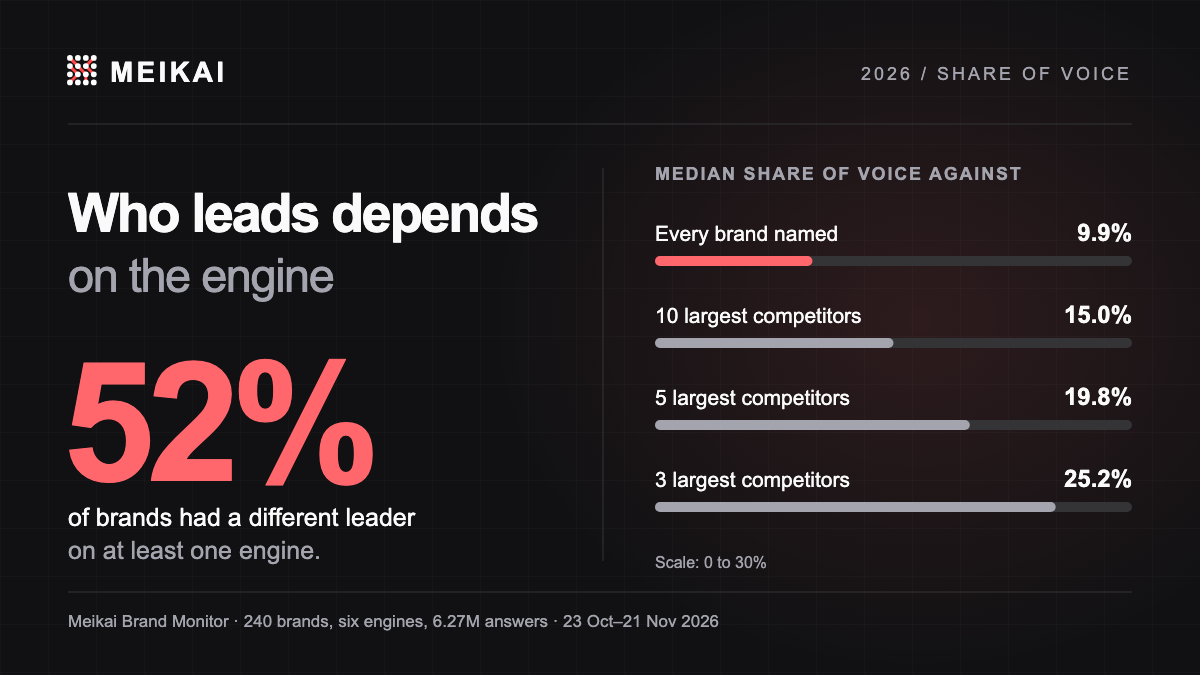
Share of voice in AI search is a brand’s share of all the brand mentions in the answers to its prompts. Across 240 brands tracked by Meikai on six AI engines over 30 days, the median brand had a share of voice of 9.9% against every brand Meikai recognised in its answers. Measured against only itself and its five largest competitors, the median brand had 19.8%. For 125 of the 240 brands, the brand with the highest share of voice changed from one engine to another.
Before comparing share of voice between brands, engines or reports, keep the competitor list, the counting rule and the engines the same.
What is share of voice in AI search?
It is the number of times AI answers name a brand, divided by the number of times they name any brand, over the same prompts. Meikai counts every mention, so a brand named three times in one answer counts three times.
Visibility is the share of answers that name the brand at least once. A brand can have high visibility and a low share of voice when the answers that name it also name many competitors.
How much does the competitor list change share of voice?
The median brand’s share of voice ranged from 9.9% to 25.2%, depending on the list of brands it was measured against. The answers to the median brand’s prompts named 77 different brands, and the shorter the list, the higher the brand’s share of voice:
| Measured against | Median share of voice |
|---|---|
| Every brand Meikai recognised in the answers | 9.9% |
| The brand and its 10 largest competitors | 15.0% |
| The brand and its 5 largest competitors | 19.8% |
| The brand and its 3 largest competitors | 25.2% |
For the median brand, the brand itself and its five largest competitors took 59.1% of all mentions, and the other 40.9% went to brands outside that group. A report against a short competitor list leaves those brands out, and two reports that use different lists cannot be compared.
Does counting mentions or answers change the ranking?
The tracked brand’s rank changed with the counting method for 87 of the 240 brands (36.3%). We ranked the brands named in each brand’s answers in two ways: by every mention, and by the number of answers naming each brand. The median difference in the tracked brand’s share of voice between the two methods was 1.5 points.
Counting every mention favours brands named several times in one answer. Counting answers favours brands named in many answers. A report should state which method it uses.
Do AI engines agree on who leads share of voice?
For 125 of the 240 brands (52.1%), the brand with the highest share of voice was not the same on all six engines. For 56 (23.3%), three or more different brands led across the six engines. The tracked brand led on all six engines for 52 brands and on some but not all for 70.
The tracked brand’s own share of voice moved between engines too. Among the 232 brands named on all six engines, the median gap between a brand’s best and worst engine was 5.5 points of share of voice, and the median ratio was 1.7.
Engines that named more brands per answer tended to have higher median visibility, from 12.3% to 22.2%, while median share of voice stayed between 9.3% and 10.3%:
| Engine | Median visibility | Median share of voice | Brands named per answer, on average | Answers naming no recognised brand |
|---|---|---|---|---|
| Google AI Mode | 22.2% | 10.0% | 2.86 | 31.6% |
| Copilot | 19.9% | 9.3% | 2.78 | 37.3% |
| Gemini | 19.7% | 9.8% | 2.60 | 43.2% |
| ChatGPT | 18.8% | 10.0% | 2.47 | 36.9% |
| Google AI Overviews | 18.3% | 10.3% | 2.55 | 37.0% |
| Perplexity | 12.3% | 9.8% | 1.67 | 55.0% |
Perplexity named no recognised brand in 55.0% of its answers, and its median visibility was the lowest. Its median share of voice was close to the other engines’, because share of voice only counts the answers that name brands.
Nike, Meikai’s demo brand, shows the same pattern. Nike was named in 69.7% of its ChatGPT answers and 39.2% of its Perplexity answers, but its share of voice was 24.0% and 21.4%. It led Adidas on all six engines, by margins from 0.3 points on Gemini, effectively a tie, to 4.0 points on Google AI Mode.
Where does a competitor’s lead come from?
For 150 of the 240 brands, the competitor named most often over the period had more mentions than the brand itself. We compared the two prompt by prompt, counting the prompts whose answers named at least one recognised brand (a median of 139 per brand). Of these 150 brands, the median brand was behind on 68.9% of its prompts. The tenth of prompts with the largest gaps accounted for 43.7% of the mentions by which the competitor was ahead, summed over the prompts where it led.
A report broken down by prompt shows where the competitor has more mentions. The prompts with the largest gaps are the place to start: read the answers and the sources they cite, then decide whether owned content, earned media or the prompt set itself needs work.
How to benchmark share of voice against competitors
- Write down the competitor list, and whether share of voice is measured against that list or against every brand recognised in the answers. Keep both the same between reports.
- Decide whether to count every mention or each answer once, and keep that rule.
- Report each engine separately, with visibility next to share of voice. A brand that leads on one engine may not lead on another.
- Check which brand leads on each engine, not only overall.
- Rank prompts by the competitor’s lead and read the answers for the top tenth before planning content.
- Report prompts that name your brand separately from category prompts. They probably raise your share of voice.
- Keep the number of answers next to each figure, and run each prompt enough times that the figure stops moving between runs.
For how many runs a prompt needs, see our prompt repetition study. For choosing engines market by market, see our guide to regional engine coverage.
How does Meikai report share of voice?
The Meikai Visibility dashboard shows each brand’s share of voice in the current view, next to visibility, mentions and average position. The view can be filtered by topic, funnel stage, persona, AI engine, date range and prompt cycle. The dashboard lists the prompts where the brand has its highest and lowest share of voice, ranks the brand against its competitors, and opens a detail panel for each competitor. Citation views show which sources appear in the answers, and the dashboard can be exported for reporting.
Agencies and groups with several brands can compare them in Portfolio. Our agency guide to running many clients covers that set-up. Or talk to Meikai about a share-of-voice benchmark for your category.
How we measured
Meikai Brand Monitor data from 23 October to 21 November 2026. We kept every brand tracked on all six engines (ChatGPT, Copilot, Gemini, Google AI Mode, Google AI Overviews and Perplexity) with at least 200 answers per engine. Of these 244 brands, 4 were never named in their own answers, which left 240 brands and 6.27 million answers. The brands come from several markets and are not named, except Nike, Meikai’s demo brand.
The brands counted in each answer are those Meikai recognises for the tracked brand: the brand itself and the other brands detected in its answers. A mention is one naming of a brand in an answer. Share of voice is a brand’s mentions divided by the mentions of all recognised brands over the same answers. Visibility is the share of answers that name the brand at least once. The Meikai dashboard excludes names that a brand has chosen to ignore, so its figures can differ slightly from these.
A brand’s largest competitors are the other brands with the most mentions in its answers over the period, across all engines. The leader on an engine is the brand with the most mentions in the tracked brand’s answers on that engine. For the prompt comparison, the gap on each prompt is the top competitor’s mentions minus the brand’s mentions. The share held by the top tenth of prompts is the sum of their positive gaps divided by the sum of all positive gaps. Figures are medians across brands.
Some prompts name the tracked brand. We did not separate them, so the brand’s own figures may be higher than they would be on category prompts alone.
Frequently asked questions
Which software provides repeatable AI competitor comparisons for board reporting?
Look for a tool that keeps the prompts, competitor list, engines and metric definitions fixed between reports, shows the number of answers behind each figure, and breaks share of voice down by engine and prompt. Meikai's Visibility dashboard shows share of voice by engine, lists the prompts with the brand's highest and lowest share of voice, and can be exported; Portfolio compares several brands.