 MEIKAI
How agencies benchmark several clients against competitors in AI search
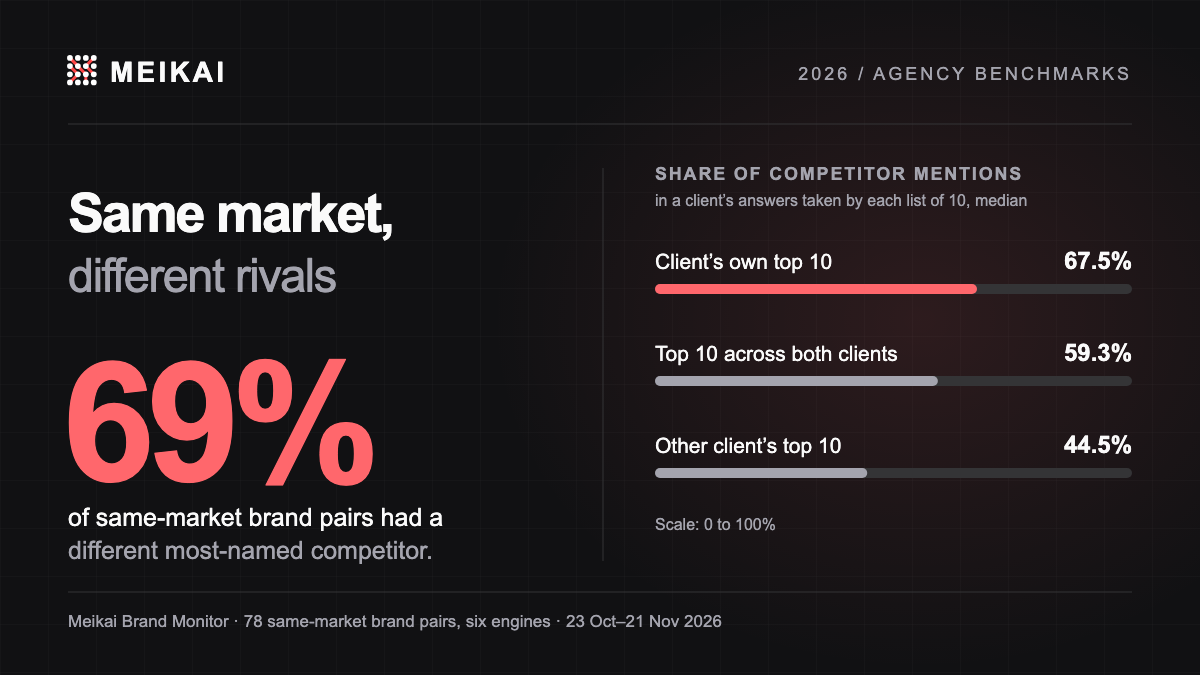
An agency that benchmarks several clients against one competitor list leaves out some of each client’s own competitors. We looked at 78 pairs of brands tracked by Meikai in the same market whose AI answers had at least three of their ten most-named competitors in common. A client’s own ten most-named competitors took a median 67.5% of the competitor mentions in its answers. The other client’s ten took 44.5%, and a combined list of the ten brands named most across both clients’ answers took 59.3%.
Use each client’s own competitor list in its own report, and the combined list when comparing clients with each other. Label every figure with the list it was measured against.
How many brands do AI answers name for one client?
In our share-of-voice study of 240 brands tracked by Meikai on six AI engines over the same 30 days, the answers to the median brand’s prompts named 77 different brands, the brand itself included. Across those 240 brands, the ten most-named competitors took a median 69.4% of the competitor mentions, so a list of ten leaves out about three in ten mentions even when it is built from the client’s own answers.
A shared list, meaning any single list used for several clients, leaves out more. In the pairs below, at least one of a client’s five most-named competitors was missing from the other client’s ten in 137 of 156 cases.
How much does a shared competitor list miss?
We paired brands in the same country whose ten most-named competitors had at least three names in common, as a stand-in for brands in the same category. This gave 78 pairs in seven markets, and the median pair had 5 of 10 names in common. Within each pair, we removed both brands from every list. For each client, we then measured the share of the competitor mentions in its answers that went to the brands on each of three lists:
| Competitor list | Median share of the client’s competitor mentions |
|---|---|
| The client’s own 10 most-named competitors | 67.5% |
| Combined list: the 10 brands named most across both clients’ answers | 59.3% |
| The other client’s 10 most-named competitors | 44.5% |
We counted each pair twice, once for each client, which gives 156 cases. Taking the gap client by client, the combined list took a median 4.5 points less than the client’s own list, and 10 points or more less in 48 of the 156 cases. The other client’s list took a median 23.1 points less. These are medians of the gaps, so they differ from the gaps between the medians in the table.
The gaps were smaller for the 31 pairs with six or more names in common: 2.3 points for the combined list and 11.7 points for the other client’s list.
What does a combined list do to a client’s share of voice?
Here we measured share of voice against a list of ten: the client’s mentions divided by its own mentions plus those of the ten brands on the list, in the client’s answers. This differs from share of voice against every brand recognised in the answers, which our share-of-voice study uses. Against its own ten most-named competitors, the median client had 12.4%.
The combined list gave a higher share of voice in 132 of the 156 cases and the same figure in the other 24. The competitors the combined list leaves out drop out of the total, which raises the client’s share. It could not give a lower figure, since a client’s own ten are by definition the ten with the most mentions. The median increase was 0.6 points. It was 5 points or more in 20 cases (12.8%), and the client moved up at least one place among the 11 brands in 26 cases (16.7%). The same answers can therefore put a client higher in a cross-client benchmark than in its own report.
Do clients in the same market have the same most-named competitor?
In 54 of the 78 pairs (69.2%), the two clients had a different most-named competitor. Among the 31 pairs with six or more names in common, it differed for 19 (61.3%). Two clients can have most of their competitors in common and still have different most-named competitors, so take each client’s from its own answers.
Does a client face the same competitors in every country?
Meikai tracked 15 of the brands in two or more countries. Comparing two of a brand’s countries, the median brand had 4 of its 10 most-named competitors in common. Its most-named competitor was the same in every country for 4 of the 15 brands. We matched names exactly, so a brand spelled differently in two markets counts as two brands, and the true overlap may be higher.
For a client tracked in several markets, keep a competitor list for each market. Our guide to regional engine coverage covers which engines to track in each market.
How to benchmark several clients against competitors
- Build each client’s competitor list from the brands named in its own answers, market by market, and review it each month.
- For comparisons between clients, use a combined list: the brands named most across all the clients in the comparison. We measured pairs, and with more clients a combined list of ten covers less of each one, so check its share of each client’s competitor mentions.
- Run the comparison on the same category prompts, engines, market and dates for every client. Keep questions about one client’s products in that client’s own report.
- Label every share-of-voice figure with the list it was measured against. A figure against the combined list cannot be compared with one against the client’s own list.
- Show each client which of its competitors the combined list leaves out, and their share of the mentions.
- Report each client’s most-named competitor from its own answers, even when the benchmark uses a combined list.
- Record the date whenever a list changes, and compare figures only within the same list.
Our guide to the AI engines agencies should compare covers prompt selection for a shared benchmark, and our share-of-voice study covers counting rules and differences between engines.
How does Meikai support multi-client competitor benchmarks?
In Meikai, each client is a brand with its own Competitors list, where competitors can be added, edited, ignored, favourited, imported and exported. Adding and editing need an editor or owner role, and read-only users can export. Brand Manager creates, duplicates and imports brands, and Portfolio compares visibility across the brands in one company account, with up to seven brands per competitor chart.
For client delivery, Visibility reports export as PDF or PPT, and deck exports can carry white-label branding. The Report Builder puts a brand’s visibility next to its competitors’ in one table, exports to XLSX or CSV, and can email a saved report on a schedule. Our agency guide to running many clients covers access and pricing, or talk to Meikai about a benchmark across your clients.
How we measured
Meikai Brand Monitor data from 23 October to 21 November 2026 on ChatGPT, Copilot, Gemini, Google AI Mode, Google AI Overviews and Perplexity. We kept the 240 brands tracked on all six engines with at least 200 answers per engine and named at least once in their own answers. Pairs and countries use the 190 of them with a country on record. No brand is named.
A brand’s competitors are the other brands Meikai recognises in the answers to its prompts. A mention is one naming of a brand in an answer. A brand’s most-named competitors are those with the most mentions in its answers over the period, across all engines. Brand names were matched exactly, ignoring case.
A pair is two brands in the same country whose ten most-named competitors have at least three names in common. We use these shared competitors as a stand-in for a shared category. The 78 pairs involve 77 brands, so some brands appear in more than one pair. Within a pair, we removed both brands from every list, so no list contains either client. This, and the smaller set of 77 brands, is why the client’s own ten took 67.5% here against 69.4% across all 240 brands. The combined list is the ten brands with the most mentions across both clients’ answers. The share taken by a list is the share of all competitor mentions in a client’s answers that go to brands on it.
Pair figures are medians across the 156 cases, one per client in each pair, unless given as a count of pairs or cases. Other figures state their own base. The pairs come from brands Meikai tracks and may not represent every category. The two brands in a pair are not necessarily clients of the same agency.
Frequently asked questions
Should agencies use one competitor list for every client?
Use one combined list to compare clients with each other, and each client’s own list in its own report. In 78 pairs of same-market brands, the client’s own ten most-named competitors took a median 67.5% of its competitor mentions, a combined list of the ten brands named most across both clients took 59.3%, and the other client’s ten took 44.5%.
Which platforms let agencies customise competitor sets by client?
Look for a platform where each client has its own competitor list that can be edited, imported and exported, and where cross-client views state which list they use. In Meikai, each client is a brand with its own Competitors list, and Portfolio compares the brands in one company account.
Where can agencies buy multi-client AI visibility reporting software?
Meikai sells plans for agencies. When comparing platforms, check for a competitor list per client, comparisons across clients, client-ready deck exports with white-label branding, scheduled reports and cost per client. Our agency guide to running AI visibility across many clients covers these points.
Can I compare several brands and markets in one AI visibility account?
In Meikai, Portfolio compares visibility across the brands in one company account, and the Visibility dashboard can be filtered by AI platform, topic and date range. Keep a competitor list for each market: for the 15 brands we tracked in two or more countries, the median brand had 4 of its 10 most-named competitors in common between two countries.